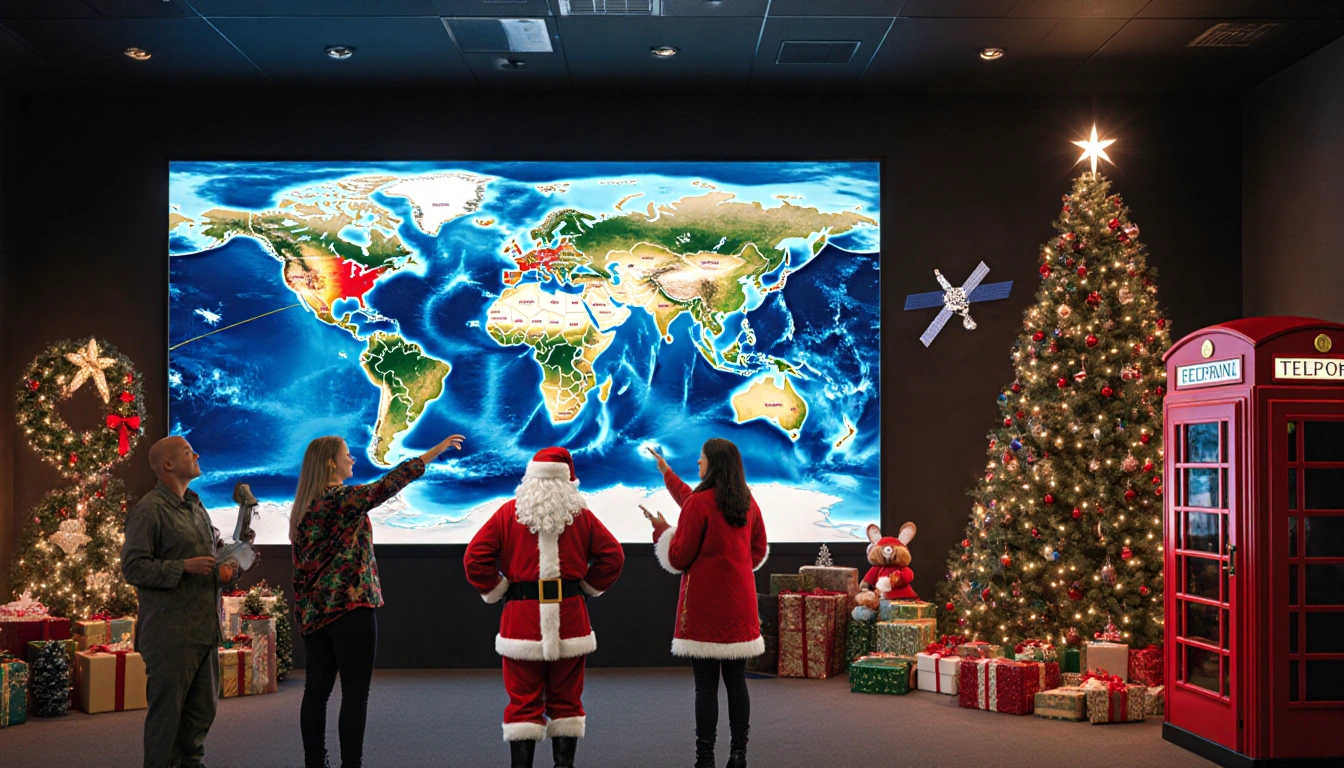

For 70 years, the North American Aerospace Defense Command (NORAD) has answered thousands of holiday calls as it tracks Santa’s journey across the globe. More than 1,000 volunteers will be taking calls to 1-877-HI-NORAD on Christmas Eve from 4 a.m. to midnight Mountain Standard Time, and for the first time this year, callers can place a request through the program’s website-an option that should make it easier for people outside North America to participate.
A Night of Calls and Volunteers
Last year, about 380,000 calls came into a hangar festooned with Christmas decorations at Peterson Space Force Base in Colorado Springs, the home of NORAD. Volunteers answer the line in a dedicated facility, and the program now offers a website that lets people follow Santa’s journey in nine languages, including English and Japanese. The hotline remains a holiday tradition that brings together children and adults who want to know whether Santa will find them.
Tracking Santa with Advanced Technology
According to Col. Kelly Frushour, a NORAD spokesperson, the same combination of radar, satellites and jets that helps NORAD carry out its mission throughout the year make it capable of tracking Santa’s progress starting from the international date line over the Pacific Ocean. She added that Rudolph’s nose gives off a heat signature similar to a missile that is picked up by NORAD’s satellites. “Faster than starlight,” Michelle Martin, a NORAD staffer and Marine veteran, explained when asked how quickly Santa can be tracked.
Stories from the Hotline
One year, a girl was upset after hearing that Santa was on his way to the International Space Station, where two astronauts were stranded. “Thankfully, by the time the call was over, Santa Claus had moved on to another destination and the child was reassured that Santa was not trapped in space and was going to make it to her house later that evening,” Frushour said.
A special-needs man named Henry, who calls every year, once asked if the jet pilot escorting Santa through North America could put a note in the plane letting Santa know he was in bed and ready for him to come. Martin said she explained that Santa travels “faster than starlight.” She added, “I don’t know that our pilot can catch up with him fast enough. He just waves and he goes.”
The Origins of a Holiday Tradition
The tradition started in 1955 when NORAD’s predecessor, the Continental Air Defense Command (CONAD), was on the lookout for any sign of a possible nuclear attack from the then-Soviet Union. NORAD says a child mistakenly called the combat operations center and asked to speak to Santa Claus. The commander on duty, Air Force Col. Harry Shoup, didn’t want to disappoint the child, so he ordered staffers to start tracking Santa and take calls from children.
The first phone call may have been the result of a misprint or a misdial of a number included in a Sears advertisement in the Colorado Springs newspaper encouraging children to call Santa. The legend developed into the first call coming into a dedicated hotline that connected the command with a general in case of an attack. In 2015, The Atlantic magazine doubted the flood of calls to the secret line, saying a call to a public phone line was more probable and noting that Shoup had a flair for public relations.
In a 1999 interview with The Associated Press, Shoup recalled playing along once he figured out what was happening. He told the first caller, “Ho, ho, ho, I am Santa.” “The crew was looking at me like I had lost it,” he recalled, describing how he had told his staff what was happening and told them to play along, too.
It’s not clear what day the first call came in, but by Dec. 23 of that first year, The Associated Press reported that CONAD was tracking Santa. CONAD soon became North American Aerospace Defense Command. It used to operate inside nearby Cheyenne Mountain, where a network of tunnels had been blasted out of the mountain’s hard granite so NORAD officers could survive a nuclear attack.
Legacy and Modern Day
Today, the program is a blend of science, service and holiday spirit. Dr. Eileen Kennedy-Moore, PhD, host of the Kids Ask Dr. Friendtastic Podcast, shares advice on broaching the subject this holiday season, reminding families that the tradition is about wonder and community. The hotline’s continuity shows how a wartime command has turned a mistake into a cherished cultural touchstone.
Key Takeaways
- More than 1,000 volunteers answer the NORAD Tracks Santa hotline from 4 a.m. to midnight on Christmas Eve.
- The program now offers a website that lets callers follow Santa’s journey in nine languages.
- The tradition began in 1955 after a child’s misdial led a military commander to answer Santa’s call and set the practice in motion.
The holiday season will once again bring together children, adults, and a team of volunteers who keep the spirit of Santa alive-one call at a time.