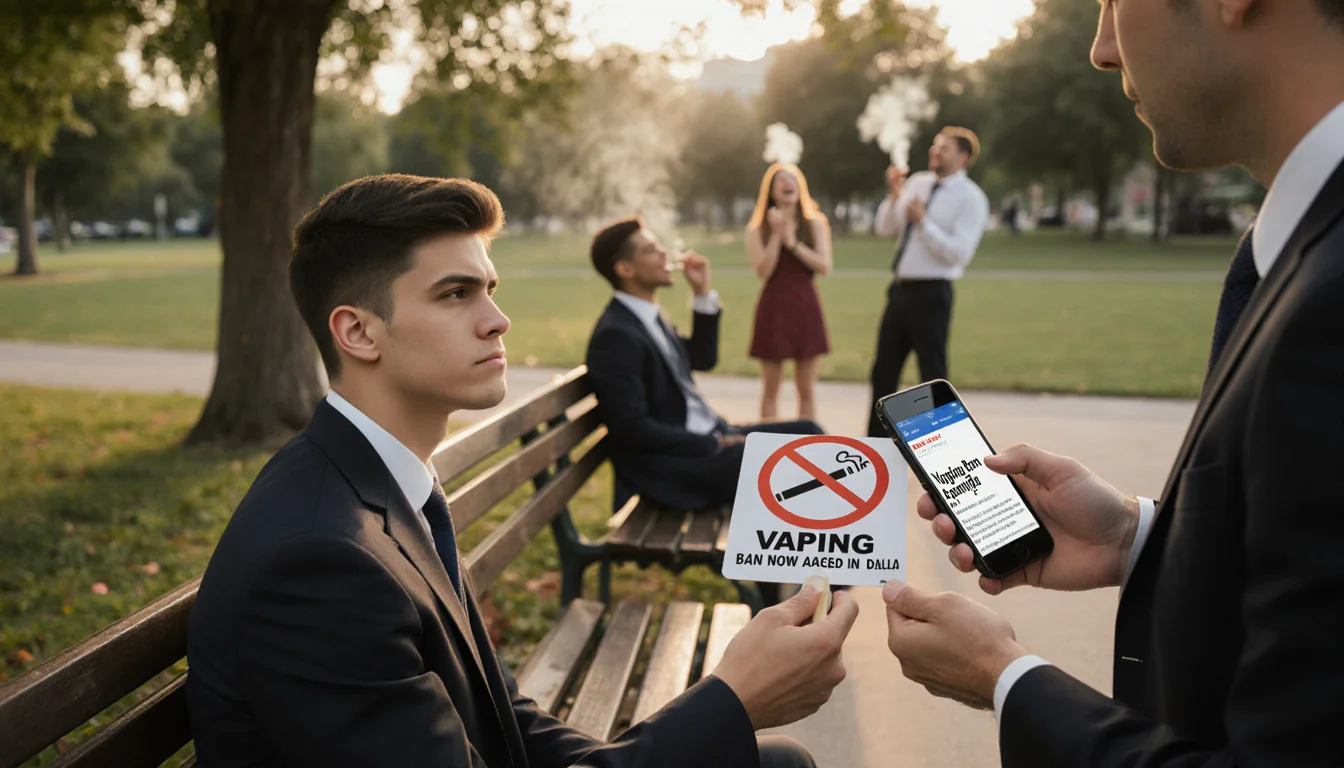

On Thursday, Dallas officially put a new citywide ban on vaping into effect, expanding its long‑standing smoke‑free regulations to include e‑cigarettes and other electronic nicotine devices.
The New Ordinance
The ordinance, approved by the Dallas City Council last year, adds vapes to the list of products prohibited in public indoor spaces and other designated smoke‑free areas. Those areas include bars, restaurants, workplaces, public transit, public parks, and any enclosed public space. Vaping is also banned within 15 feet of entrances to public buildings. Violations can lead to fines of up to $500. The changes take effect immediately, meaning residents and businesses must adapt their policies overnight. Signage will be updated across the city to reflect the new restrictions.
Health Rationale Behind the Ban
City leaders say the change is an effort to protect residents from secondhand exposure and to curb the growing number of young people using e‑cigarettes. “Similar to how smoke‑free ordinances passed and spread as people became more aware of the health effects and concerns, they’re seeing that vaping also needs to be added to these restrictions,” said Dr. Philip Huang, the director of Dallas County Health and Human Services. “It’s not saying people can’t vape; they can do it. But they just can’t do it in these enclosed public spaces where other people are exposed – same restrictions that happen with cigarette smoking.” Huang added that many people still assume vaping is harmless. According to Dallas’ Office of Environmental Quality and Sustainability, smoke from e‑cigarettes contains chemicals that are harmful and can worsen the air quality, especially in indoor spaces. “It has this sense that, ‘Oh this is safer’ or that it’s just harmless water vapor, but it’s really not,” he said. “Because it’s really that secondhand exposure also that is not just the person using it, but it’s the people who are exposed to it that have to breathe it.”
Enforcement and Public Awareness
The city is focusing on community outreach, using updated signage, social media posts, and public messaging to make residents aware of the changes. Health advocates say the timing may even help longtime users who are looking to quit. “You look at what the number one New Year’s resolution is for people who are using these products. A lot of times, it’s to quit using these products. So this is a nice way to help people to quit also,” said Huang. The Dallas City Council has made it clear that compliance typically improves quickly once the public is aware of the new policy through signage, social media, and other means.
Dallas Joins Other Texas Cities
Dallas now joins other major Texas cities, including Austin, Houston, and San Antonio, that have already adopted similar rules. Huang, who previously oversaw Austin’s transition to a vape ban when he worked there, said compliance typically improves quickly once the public is aware of the new policy. He added, “I think these policies can help people to quit. And that’s what we saw with conventional cigarettes also.”
Support for Teens and Youth
Teens hoping to break nicotine habits can also find support through Dallas County’s free “Not On Tobacco” program for ages 14 to 19. The program covers addiction, triggers, stress management, and strategies for quitting. The program is part of the city’s broader effort to address the high rates of e‑cigarette use among middle and high school students, a demographic that, according to the American Lung Association, includes more than 1.6 million U.S. students. In 2020, Dallas County reported its first vaping‑related death, which involved a teenager.
Key Takeaways
- Dallas’ new ordinance bans vaping in all public indoor and designated smoke‑free areas, with fines up to $500.
- Dr. Philip Huang emphasizes that vaping is still harmful to secondhand exposure and that the ban mirrors cigarette restrictions.
- The city is deploying signage, social media, and outreach to ensure residents are aware, and it offers a free youth program to help teens quit.
The ban marks a significant step for Dallas, aligning the city with statewide efforts to protect public health and reduce youth vaping. Residents, businesses, and public officials will need to adjust quickly to the new rules, but the city’s comprehensive outreach and support programs aim to make the transition smoother for all.