
At a Glance
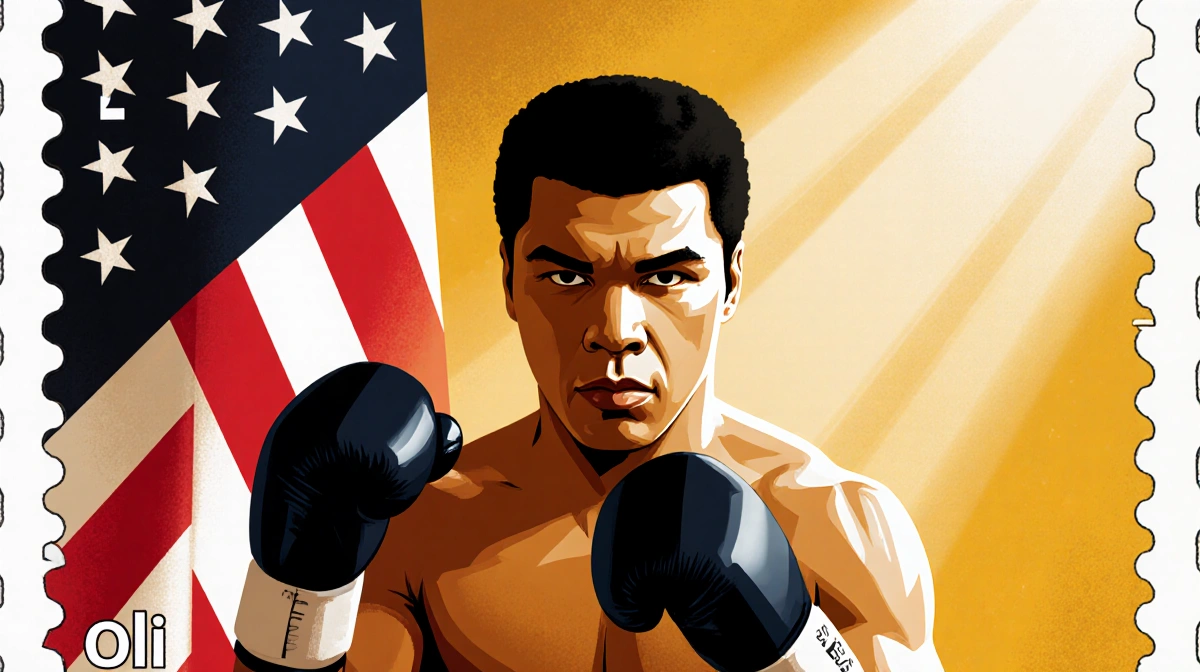
- Muhammad Ali is appearing on a U.S. commemorative postage stamp for the first time
- The stamp features a 1974 black-and-white photo of Ali in his boxing stance
- 22 million stamps printed; once gone, they won’t be reprinted
- Why it matters: The Forever Stamp keeps Ali’s legacy alive every time mail is sent
Muhammad Ali’s famous joke about becoming a postage stamp is now reality. The three-time heavyweight boxing champion will appear on a commemorative U.S. postage stamp, marking the first time his image has been featured on American mail.
The Champ’s Stamp
The Muhammad Ali Forever Stamp will be publicly unveiled during a first-day-of-issue ceremony Thursday in Louisville, Kentucky. This is Ali’s birthplace and home to the Muhammad Ali Center, which celebrates his life and legacy.
Each sheet contains 20 stamps. One shows the Associated Press photo from 1974 of Ali in his iconic boxing pose. The other image captures him in a pinstripe suit, honoring his humanitarian work.
The U.S. Postal Service printed 22 million stamps. Officials emphasize that once these sell out, no additional prints will be made. The limited run is expected to generate strong interest from both collectors and the general public.
Lonnie Ali’s Reaction
Lonnie Ali, Muhammad’s wife of nearly 30 years, expressed deep emotion about the honor.
“As sort of the guardian of his legacy, I’m thrilled. I’m excited. I’m ecstatic,” she told Cameron R. Hayes. “Because people, every time they look at that stamp, they will remember him. And he will be in the forefront of their consciousness. And, for me, that’s a thrill.”
She believes the stamp carries special meaning because it highlights Ali’s mission of spreading compassion and human connection.
“He did it one person at a time,” she said. “And that’s such a lovely way to connect with people, to send them a letter and to use this stamp to reinforce the messaging in that life of connection.”
Since these are Forever Stamps, they remain valid for First-Class Mail indefinitely. Lonnie Ali calls this the “ultimate” tribute.
“This is going to be a Forever Stamp from the post office,” she said. “It’s just one of those things that will be part of his legacy, and it will be one of the shining stars of his legacy, getting this stamp.”
Creation Process
Lisa Bobb-Semple, USPS director of stamp services, said the idea emerged shortly after Ali’s death in 2016. However, stamp development requires extensive time. USPS rules mandate that individuals must be deceased for at least three years before appearing on stamps, with presidents being the exception.
While USPS worked behind the scenes, a friend of Ali launched the #GetTheChampAStamp campaign. This effort sparked public interest and support.
“We are really excited that the stars were able to align that allowed us to bring the stamp to fruition,” said Bobb-Semple, who initially had to keep the project confidential. “It’s one that we’ve always wanted to bring to the market.”
The Citizen Stamps Advisory Committee, appointed by the postmaster general, selects stamp subjects. They meet quarterly with Bobb-Semple’s team to review public suggestions. Typically, 20 to 25 commemorative stamp issues release annually.
After selection, Bobb-Semple collaborates with art directors on design. The stamp undergoes extensive legal review before public release.
Design Selection
Antonio Alcalá served as art director and designer for the Muhammad Ali stamp. He reviewed hundreds of images before narrowing the choices.
The final selection was an AP photograph taken by an unnamed photographer. It captures Ali in his prime, wearing boxing gloves while gazing directly into the camera.
Alcalá emphasizes that every USPS stamp tells a story.
“Postage stamps are miniature works of art designed to reflect the American experience, highlight heroes, history, milestones, achievements and natural wonders of America,” he said. “The Muhammad Ali stamps are a great example of that.”
Ali’s Legacy
Muhammad Ali died in 2016 at age 74 after living with Parkinson’s disease for over three decades. His accomplishments extend far beyond boxing.
- Won Olympic gold medal in 1960
- Received United Nations Messenger of Peace award in 1998
- Awarded Presidential Medal of Freedom in 2005
Born Cassius Clay Jr., Ali changed his name after converting to Islam in the 1960s. He became an outspoken advocate on race, religion, and war during a time when many Black Americans struggled to be heard.
In 1967, Ali refused induction into the U.S. Army, citing religious beliefs and opposition to the Vietnam War. This decision cost him his heavyweight championship title and banned him from boxing for over three years.
Convicted of draft evasion and sentenced to five years in prison, Ali remained free during appeals. The U.S. Supreme Court overturned his conviction in 1971, solidifying his status as a global figure.
Later in life, Ali became a humanitarian who used his fame to promote peace, religious understanding, and charitable causes. Parkinson’s disease limited his speech and movement, but he continued his advocacy work.
Today’s Relevance
The stamp arrives during a period of political division in America and globally. Lonnie Ali believes her husband would handle current tensions with his characteristic compassion.
She says he would likely “block a lot of this out” and continue connecting with individuals daily through kindness.
“We have to mobilize Muhammad’s life and sort of engage in the same kinds of acts of kindness and compassion that he did every day,” she said.
The stamp serves as both tribute and reminder of Ali’s enduring message of human connection and understanding.