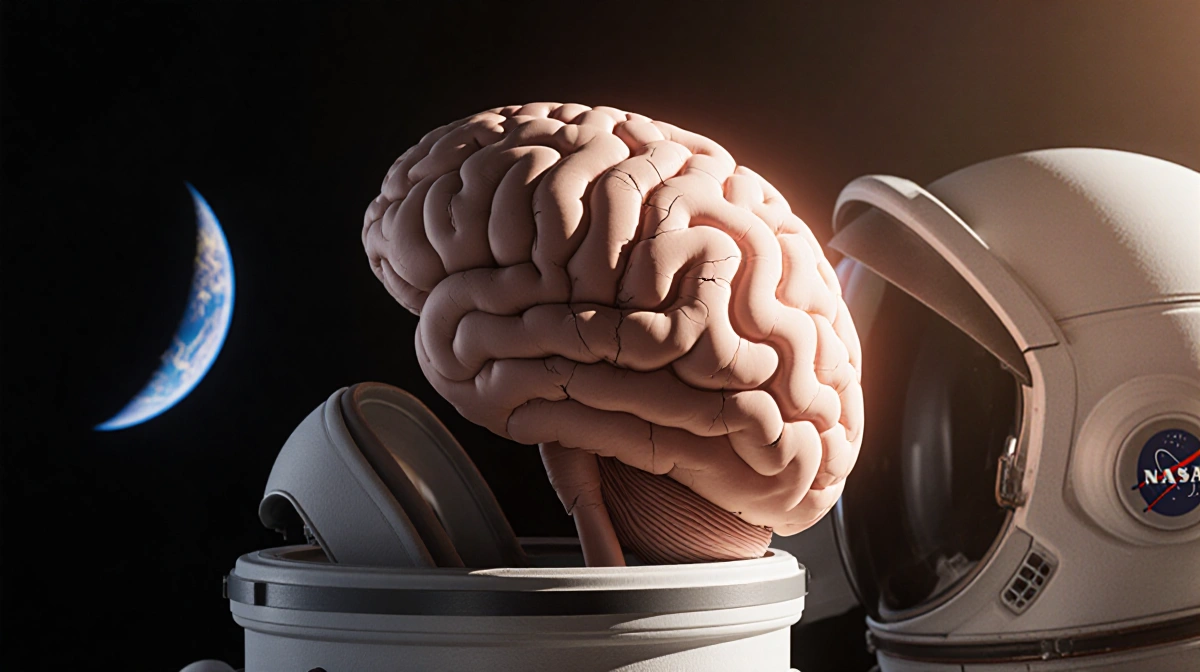

Astronauts’ brains physically tilt upward and shift back inside the skull after time in orbit, with longer missions driving the largest changes, according to a study published Monday in the journal Proceedings of the National Academy of Sciences.
At a Glance
- Brains shifted up to 2 mm within the skull after six-month stays
- Year-long missions produced the most pronounced changes
- No serious symptoms like headaches or cognitive loss detected
- Why it matters: Findings shape NASA plans for moon bases and Mars trips
The study analyzed MRI scans from 26 astronauts taken before and after flights lasting two weeks to roughly one year. Researchers compared the results with scans from 24 Earth-bound civilians kept on tilted bed rest for 60 days to mimic micro-gravity.
Brain Movement Linked to Motion Sickness
Rachael Seidler, a University of Florida applied physiology professor and co-author, said the upward shift measured “a couple of millimeters”-a distance visible to the naked eye.
“The people who went for a year showed the largest changes,” Seidler noted. “Duration seems to be the driving factor.”
Affected regions sit at the top of the brain and regulate:
- Motion sickness
- Disorientation
- Balance control
Seidler said astronauts sometimes experienced “sensory conflicts” in orbit, yet the study recorded no headaches or cognitive impairment during or after flight. “That was surprising to me,” she admitted.
Earth Recovery and Simulation Data
Once back under Earth’s gravity, balance issues can appear while the brain readjusts. Scans showed the civilian bed-rest group developed similar upward shifts, though astronauts displayed greater movement.
Dr. Mark Rosenberg, who directs the Medical University of South Carolina’s aerospace neurology program and was not part of the research, called the work the first to link upward brain shifts to real operational impacts on crew members.
“We knew the brain shifts upward, but does it actually have any kind of operational impact?” Rosenberg said. “This study is able to make some of those associations.”
Implications for Deep-Space Missions
The findings arrive as NASA targets long-duration moon bases and eventual Mars voyages. Open questions include:
- Whether male and female brains respond differently
- Whether age influences change severity
- How partial gravity-one-third on Mars or one-sixth on the moon-alters recovery times
Rosenberg posed: “If you’ve been on Mars with one-third Earth’s gravity, or on the moon with one-sixth Earth’s gravity, will it take three or six times as long to get back to normal?”
Limited crew launches-roughly a dozen astronauts reach the International Space Station annually-shrink sample sizes, and the astronaut corps has historically skewed male, complicating broader conclusions.
Changes Appear Temporary
Like bone loss, muscle weakening, and fluid redistribution documented in earlier work, the brain shifts seem reversible once gravity returns. “Things more or less return to normal,” Rosenberg said.
Both researchers stress the results should not deter extended spaceflight. Instead, the data spotlight the need to monitor for lasting effects and develop countermeasures.
“Whether we care to admit it or not, we are eventually going to become a space-faring species,” Rosenberg added. “It’s only a matter of time. And these are just some of the unanswered questions that we need to sort out.”
Key Takeaways
- Even short two-week missions produce measurable brain shifts
- Six-month flights push the brain upward by millimeters
- Current evidence shows no permanent damage
- Understanding these changes is vital for future Mars crews