
At a Glance
- Developer Luke Schaef’s collaborative word-search site Words.zip has become an impromptu canvas for crude drawings and messages.
- Users highlight real words to claim colored tiles, then arrange those tiles into pictures and text visible when zooming out.
- The grid now sports everything from a cat portrait to the inevitable cartoon phallus.
- Why it matters: It’s a live demo of how even the most innocent online spaces get tagged the moment the public gains creative control.
A project meant to celebrate language has become a graffiti wall. Words.zip, an endless online word search built by developer Luke Schaef, invites visitors to hunt for hidden terms and lock them into place with a click. Once a word is accepted, its letters change from black to a color that signals rarity-purple for once-in-a-lifetime finds, green for everyday vocabulary. The twist is that the entire grid is shared in real time, so every claimed tile becomes unavailable to everyone else. Zoom out and the result looks like a million-player game of Lite-Brite, except the bulbs spell whatever the crowd feels like spelling.
How the Game Works
Loading the site drops you into the dead center of the sprawling grid. Prime real estate is already crowded with colored squares, but scroll a few screens in any direction and untouched black letters stretch to the horizon. Find a word, drag across it, and submit. If the dictionary approves, the letters flash into color and the counter for that word ticks up. From that moment on those squares are locked; no second player can overwrite them. The palette acts as a heat map: purple words have been found once, green ones dozens of times.
From Lexicon to Wall Art
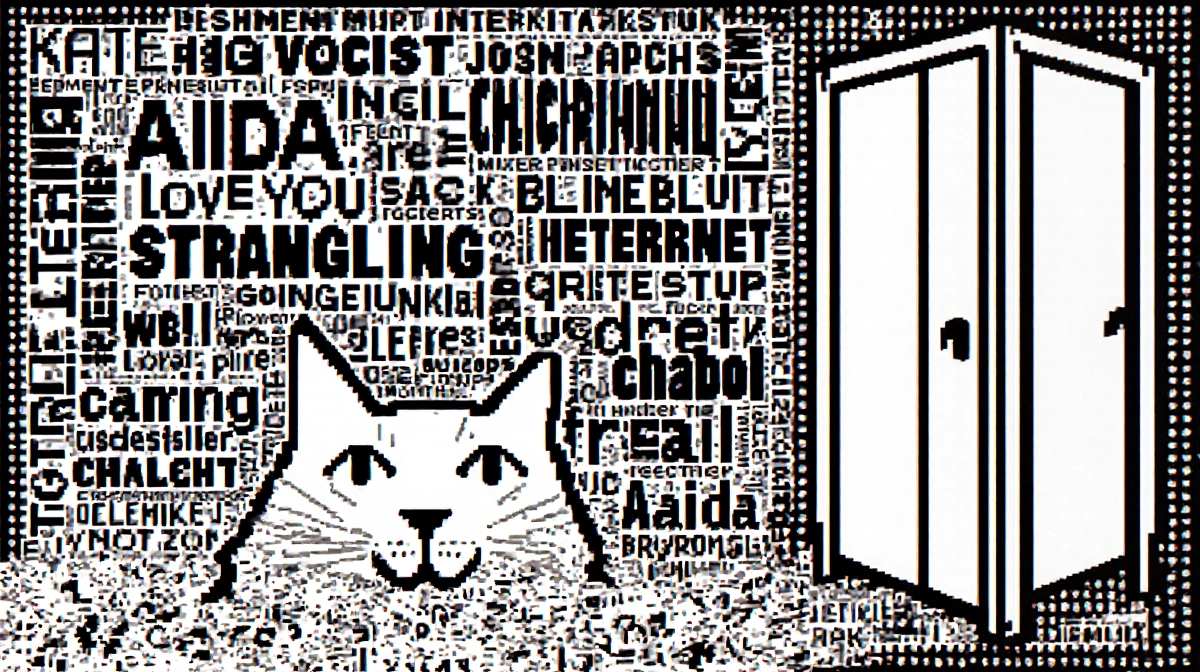
What began as a quiet quest for rare vocabulary quickly turned into collaborative pixel art. Resourceful players realized that by reserving strategic tiles they could draw pictures visible only when the view is pulled back. A meticulous cat appeared first, followed by the sentence “Where lies the strangling fruit,” a nod to author Jeff VanderMeer. Then came declarations of love-“Aida, I love you” spans several rows-and, inevitably, the internet’s favorite subject matter: a crude but unmistakable phallus. The drawings coexist alongside legitimate words, creating a collage that is half Scrabble, half bathroom-stall door.
Developer’s Take
Luke Schaef, the site’s sole creator, describes himself as someone who “likes making things that make people happy or make people think.” Reached for comment, he offered no plans to moderate the emergent artwork, noting that the communal layer is part of the experiment. “I built a sandbox,” he said. “What people build-words, poems, pictures-is up to them.” Traffic has spiked each time a new drawing trends on social media, proving the gag has legs.
Domain Name Confusion
The project’s URL, Words.zip, uses the controversial “.zip” top-level domain that Google introduced in 2023. Security researchers warned at launch that surfers might confuse a .zip site with a compressed-file download, creating phishing risk. Schaef’s game does not distribute files; it simply adopted the suffix for its techie pun value. Whether the choice helps or hurts discoverability is unclear, but it has added another layer of notoriety to the buzz.
Key Takeaways
- A single developer built a shared word search; the crowd turned it into a graffiti wall.
- Colored tiles meant to signal word rarity now form pictures and messages visible from afar.
- No moderation tools exist, letting drawings-polite and obscene-stand untouched.
- The episode underlines a familiar lesson: give strangers shared pixels and someone will draw a dick.