

The Trump administration will halt immigrant visa processing for 75 countries starting January 21, the State Department announced Wednesday, citing concerns that newcomers from those nations use public benefits at unacceptable rates.
At a Glance
- 75 countries, from Afghanistan to Yemen, face an immediate pause on U.S. immigrant visas
- The freeze does not affect short-term tourist, student, or World Cup visitor visas
- State Department says action stops immigrants who “extract wealth from the American people”
- Why it matters: Thousands of families hoping to reunite or resettle in the U.S. must now wait indefinitely while procedures are rewritten
The sweeping suspension targets every nation on an internal list obtained by News Of Fort Worth, including large populations such as Brazil, Egypt, Nigeria, Pakistan, and Somalia. Immigrant visas-those meant for foreigners seeking permanent residence-are the only category affected. Temporary worker, student, and tourist visas, including special World Cup travel permits, remain available.
According to News Of Fort Worth, the State Department framed the move as a safeguard against future public-benefit costs. “Immigrants from these countries take welfare from the American people at unacceptable rates,” the department claimed without releasing supporting data.
State Department Principal Deputy Spokesperson Tommy Pigott said processing will stay on hold “while the State Department reassesses immigration processing procedures to prevent the entry of foreign nationals who would take welfare and public benefits.”
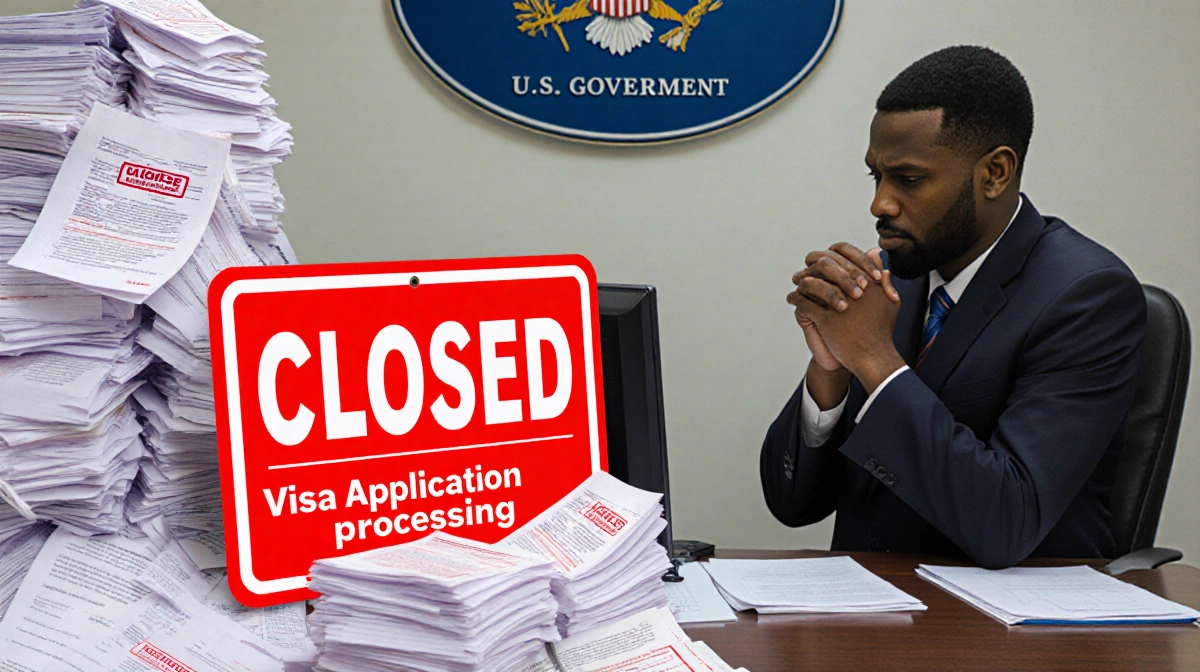
Pigott added, “The Trump administration is bringing an end to the abuse of America’s immigration system by those who would extract wealth from the American people. The State Department will use its long-standing authority to deem ineligible potential immigrants who would become a public charge on the United States and exploit the generosity of the American people.”
Most visa holders already face tight restrictions on public assistance. For example, green-card holders typically endure a five-year waiting period before they can receive food stamps, non-emergency Medicaid, or the Children’s Health Insurance Program (CHIP).
The policy escalates a series of recent immigration clampdowns. In December, the administration stopped accepting immigration applications from nationals of 19 countries. On the eve of the new announcement, it revoked temporary protected status for Somalis already living in the U.S.
Fox News first reported the plan after obtaining an internal State Department memo. A U.S. official later confirmed the complete roster of affected countries to News Of Fort Worth:
| Region | Countries |
|---|---|
| South Asia | Afghanistan, Bangladesh, Bhutan, Nepal, Pakistan |
| Southeast Asia | Burma, Cambodia, Laos, Thailand |
| Middle East | Egypt, Iran, Iraq, Jordan, Kuwait, Lebanon, Libya, Syria, Yemen |
| Africa | Algeria, Cameroon, Cape Verde, Democratic Republic of the Congo, Republic of the Congo, Eritrea, Ethiopia, Gambia, Ghana, Guinea, Haiti, Liberia, Morocco, Nigeria, Rwanda, Senegal, Sierra Leone, Somalia, South Sudan, Sudan, Tanzania, Togo, Tunisia, Uganda |
| Eastern Europe & Central Asia | Albania, Armenia, Azerbaijan, Belarus, Bosnia, Georgia, Kazakhstan, Kosovo, Kyrgyzstan, Macedonia, Moldova, Mongolia, Montenegro, Russia, Uzbekistan |
| Latin America & Caribbean | Antigua and Barbuda, Bahamas, Barbados, Belize, Brazil, Colombia, Cuba, Dominica, Grenada, Guatemala, Jamaica, Nicaragua, Saint Kitts and Nevis, Saint Lucia, Saint Vincent and the Grenadines, Uruguay |
The administration offered no timeline for how long the suspension will last, saying only that it will “remain active until the U.S. can ensure that new immigrants will not extract wealth from the American people.” The statement was posted on the department’s official X account.
Immigration attorneys told News Of Fort Worth the pause could snarl family reunification cases, employment-based green-card queues, and diversity-lottery winners from the listed nations. Because the action applies to immigrant visas rather than non-immigrant categories, H1-B high-skilled workers already sponsored by U.S. employers may still enter, but their dependents seeking permanent residence could face delays.
Critics note that most prospective immigrants must still prove financial self-sufficiency under existing public-charge rules. The new procedure suggests the administration wants an additional layer of review, though specifics remain unclear.
The State Department has not indicated whether applicants already scheduled for interviews will have appointments cancelled or simply pushed back. Consulates worldwide have begun adding notices to their websites, warning that immigrant visa services are “temporarily suspended” for the listed nationalities.
Key takeaways:
- 75 countries are now subject to an immigrant-visa freeze
- The suspension starts January 21 with no announced end date
- Only immigrant visas are affected; tourist, student, and most work visas continue
- The administration cites welfare-use concerns as justification
- The move follows earlier bans on 19 countries and the removal of Somali protected status
Families and employers awaiting green-card approval will have to monitor State Department updates for any sign of resumed processing.