


At a Glance
- Atomic-6 will test its Space Armor tiles on a SpaceX ride-share mission in October
- The Georgia startup’s shield is 15% thinner than 1940s Whipple tech and avoids creating secondary debris
- First customer Portal Space Systems will stream video of the tiles in orbit
- Why it matters: A single 1 mm fleck of metal already grounded China’s Shenzhou-20 crew, and thousands of new satellites are launching without modern protection
Atomic-6, a startup based in Georgia, has built a next-generation orbital shield designed to stop the millimeter-scale debris that older aluminum Whipple shields can’t handle without spraying metal everywhere. The company announced today that Portal Space Systems will carry the first Space Armor tiles on a spacecraft launching aboard SpaceX’s Transporter-18 mission this October, giving the industry its first in-space look at protection that is lighter, thinner, and less self-destructive than the 1940s technology most satellites still use.
From Air Force Grant to Launch Pad
The U.S. Air Force and U.S. Space Force seeded the work with a $1.2 million Small Business Innovation Research grant, tasking Atomic-6 with creating a modern debris shield. The result is a tile less than an inch thick-roughly 15% slimmer than a conventional Whipple aluminum bumper-made from non-metallic materials the company will not yet disclose.
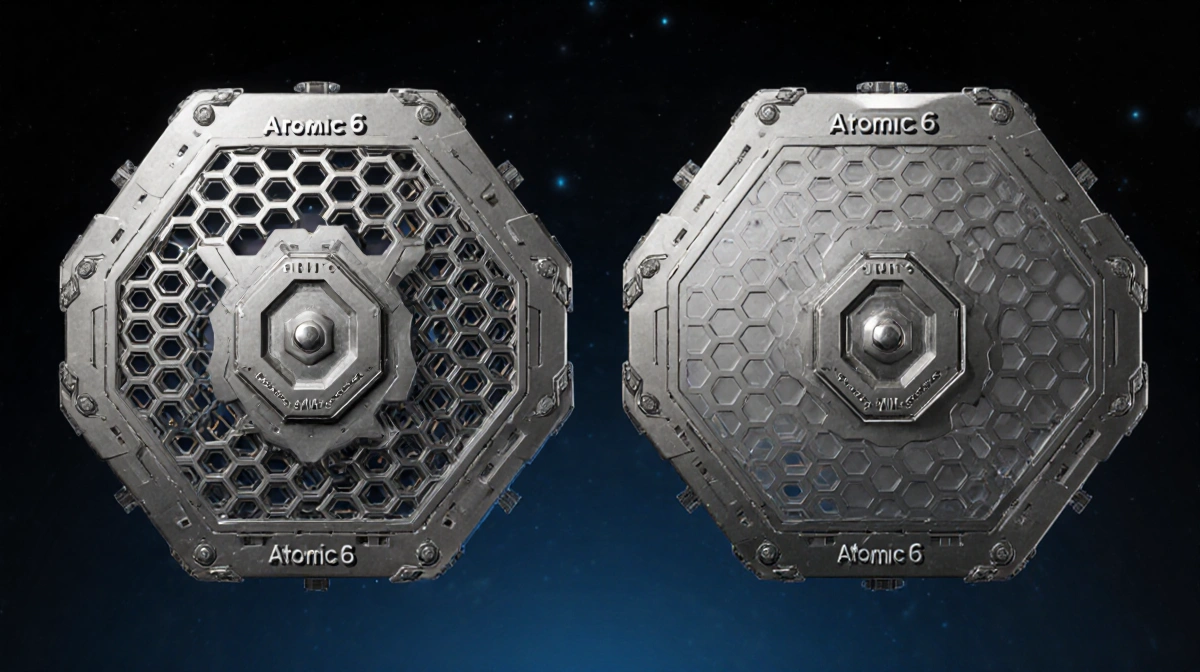
CEO Trevor Smith told News Of Fort Worth that the grant targeted a clear weakness: “Five years ago, we didn’t have [thousands] of satellites flying around, we didn’t have that activity. Necessity is the mother of invention, and because this has become a problem, you will now see more and more of these types of protections.”
Two Armor Grades for Two Threat Levels
Atomic-6 produces two tile versions:
- Space Armor Lite stops particles 3 mm or smaller
- Space Armor Max handles debris up to 12.5 mm across
The vast majority of untrackable debris in low-Earth orbit sits in the 3 mm range, moving faster than a rifle bullet. Traditional shields often survive the hit but eject clouds of aluminum that become new hazards. Smith says Space Armor’s composite structure is engineered to capture both the original fragment and the shattered shield material, eliminating most secondary debris.
Cameras Ready for a Planned Strike
Portal Space Systems will bolt the tiles to its satellite and point an onboard camera at them for the entire mission. “My hope is they actually get struck, but get struck in the tile, and we get it on camera,” Smith explained. Engineers will also review telemetry to confirm no systems were damaged, but visual confirmation of an impact mark is the gold-standard proof Atomic-6 wants before scaling up production.
Ground tests have already pelted the tiles with aluminum spheres at orbital speeds, yet the October flight will be the first time the material experiences real vacuum, thermal swings, and micrometeoroid exposure.
One-Millimeter Threat Grounded a Crew
The stakes are visible in recent history. In November 2025 a particle estimated at only 1 mm wide struck China’s Shenzhou-20 spacecraft, scarring the heat shield enough that astronauts had to find a different ride home. Space Armor is “designed to protect from the unknown,” Smith notes, because radar can’t give warning for objects that small.
Next Markets: Moon Boxes and Spacewalk Suits
Once the tiles clear qualification, Atomic-6 plans to branch out:
- Stick-on patches for astronaut EVA suits
- Panels for commercial space stations
- Protective boxes for lunar payloads
Lunar infrastructure companies have already approached the startup about shielding lander payloads from grit kicked up during descent and surface operations.
Key Takeaways
- October’s Transporter-18 mission will mark the first orbital test of non-metallic debris tiles
- Space Armor aims to replace Whipple shields invented in the 1940s
- A successful video-captured impact could open human-rated and lunar markets for the Georgia company