
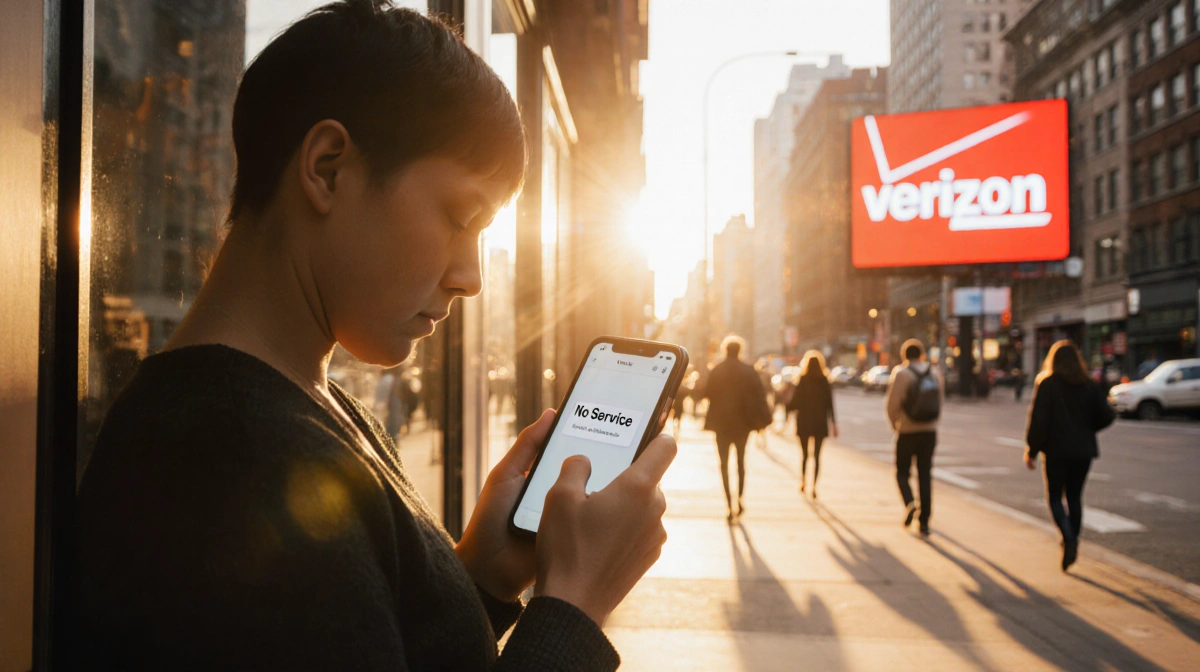

Verizon on Thursday said it will credit every affected account $20 after a nationwide cellular failure left millions offline for roughly ten hours.
The disruption, which began around noon ET on Wednesday and stretched past 10 p.m., knocked out voice and data across the country’s largest wireless network.
At a Glance
- Verizon will apply an automatic $20 credit to each impacted line
- The outage froze calls, texts, and data from ~12 p.m. to after 10 p.m. ET
- Company tells users to restart devices if problems linger
- A New York lawmaker has asked the FCC to investigate
- Why it matters: The failure severed 911 access for untold subscribers and exposed weak points in U.S. communications infrastructure
Verizon posted its apology on X: “Yesterday, we did not meet the standard of excellence you expect and that we expect of ourselves.”
Customers can claim the credit by opening the myVerizon app and tapping accept. Verizon stressed the gesture is limited: “This credit isn’t meant to make up for what happened. No credit really can. But it’s a way of acknowledging your time and showing that this matters to us.”
Anyone still seeing signal drops should power-cycle their phone. “Rebooting would be the fastest way to reconnect your phone to the network,” the carrier said.
Political Pressure Builds
Republican New York State Assembly member Anil Beephan, Jr. urged FCC Chairman Jessica Rosenworcel to open a formal probe late Wednesday.
Beephan wrote that the blackout “had a significant and unacceptable impact on public safety, including disruptions to reliable access to emergency communications and critical response systems.”
He added: “More broadly, the continued instability of a major wireless carrier raises concerns about the resiliency and reliability of our greater communications infrastructure.”
The Federal Communications Commission confirmed awareness of the outage the same day but declined to say whether an enforcement inquiry has begun.
FCC Commissioner Anna Gomez issued a separate pledge: “I will be asking our Consumer/Public Safety Bureaus to keep a close eye on this situation and investigate the source of this service disruption.”
What Triggered the Collapse?
Verizon has not publicly identified a root cause. The carrier did not answer emailed questions from Ryan J. Thompson about whether the failure stemmed from a software update, fiber cut, cyber incident, or overloaded node.
The silence leaves businesses, public-safety agencies, and consumer watchdogs guessing. If an investigation materializes, the FCC could demand network logs, outage timelines, and proof that Verizon followed federal resiliency rules.
Scale Still Unclear
Verizon serves more than 114 million retail connections, but the company has not said how many were knocked offline. Social-media complaints flooded platforms from Boston to Los Angeles, suggesting a coast-to-coast footprint.
Wireless industry veterans note that even a fractional failure can paralyze regional 911 systems that rely on Verizon backbone circuits.
Credit Math
At $20 per line, the rebate could climb into the tens of millions, depending on final eligibility rules. Verizon has not disclosed:
- Whether business accounts qualify
- If prepaid subscribers are included
- How long customers have to redeem the offer
The payout is among the largest direct-to-customer refunds in recent telecom history, eclipsing the routine $5-$10 service credits carriers sometimes issue after localized tower faults.
History of Outages
Verizon experienced a similar, though shorter, nationwide drop in October 2020 that the carrier blamed on a “routing configuration change.”
Federal law requires providers to file outage reports with the FCC when 900,000 or more user-minutes are interrupted for at least 30 minutes. The agency has not released any filings related to Wednesday’s event.
Consumer Takeaways
- Check your account: Open the myVerizon app and tap the banner to secure the credit
- Restart your phone if you still see “No Service” or failed calls
- Document issues: Save screenshots of error messages for possible additional claims
- 911 alternatives: Keep a landline or alternate carrier handy during widespread outages
Key Takeaways
Verizon’s $20 mea culpa will cost it millions but may not satisfy regulators focused on public-safety gaps. With an FCC probe possible and bipartisan political pressure mounting, the carrier could face steeper fines or new federal reliability mandates. Until a cause is disclosed, customers and first responders remain in the dark about whether another ten-hour blackout could strike without warning.