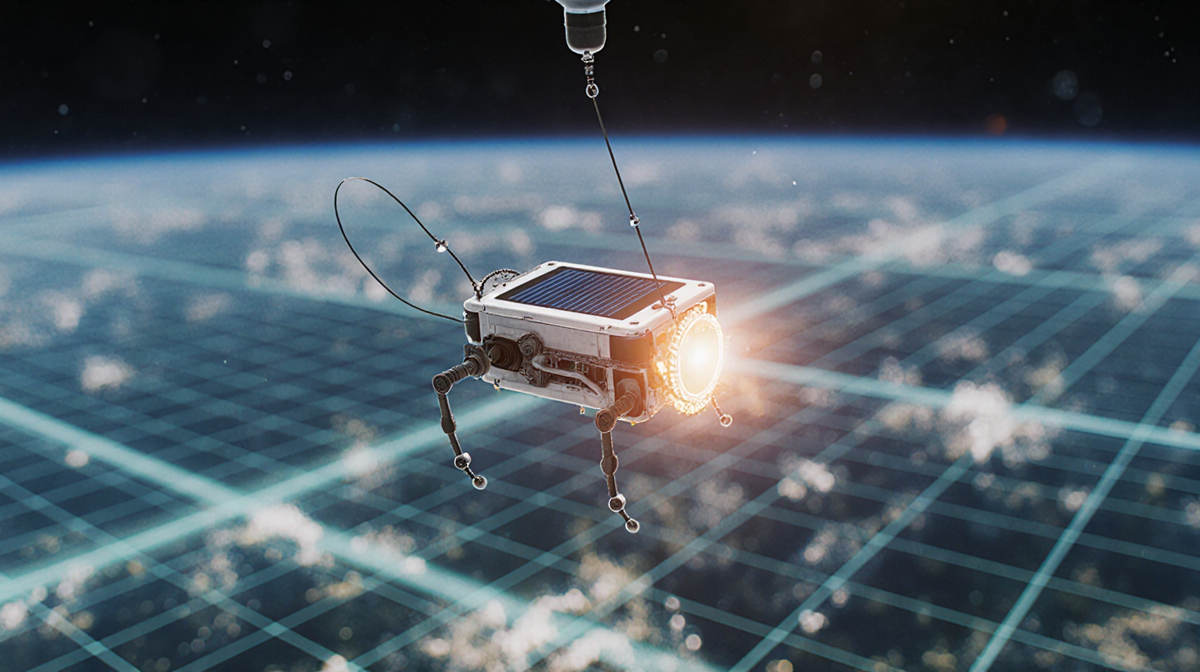

At a Glance
- A team from the University of Pennsylvania and the University of Michigan built a robot smaller than a grain of salt.
- The device measures 200 × 300 × 50 µm, well under the 1 mm threshold.
- It moves by generating an electric field instead of using tiny arms or legs.
- The robot can operate autonomously for months on a single 75-nanowatt solar cell.
The world of robotics has just crossed a milestone that seemed impossible for decades: a fully autonomous machine that is less than a grain of salt in size. The new robot, crafted by researchers at the University of Pennsylvania and the University of Michigan, measures only 200 × 300 × 50 µm and can sense, decide, and swim in water without external controls.
Miniaturization Milestone
The challenge of shrinking robots to sub-millimeter dimensions has frustrated engineers for years. At microscopic scales, gravity gives way to drag and viscosity, making tiny arms and legs fragile and ineffective. The new robot, whose first appearance was in a study announced by the two universities, achieves a size of 0.3 mm on its longest side-an order of magnitude smaller than the smallest robots previously built.
| Feature | Previous Smallest Robot | New Robot |
|---|---|---|
| Size | ~1 mm | 200 × 300 × 50 µm |
| Power source | Wired or magnetic fields | 75-nanowatt solar cell |
| Cost per unit | >$1 | as low as 1 cent |
“We have succeeded in miniaturizing an autonomous robot to 1/10,000th the size of a conventional robot,” said Mark Miskin, an assistant professor of electrical systems engineering at the University of Pennsylvania. “This opens up a whole new scale for programmable robots.”
Electric-Field Propulsion
Traditional aquatic robots rely on moving parts to push water backward, following Newton’s third law. In a viscous medium, however, tiny limbs cannot generate sufficient thrust. The research team circumvented this by using an electric field to move charged particles in the liquid. The resulting drag on the particles drags nearby water molecules, creating a current that propels the robot.
- No moving parts – eliminates wear and tear.
- Light-driven – an LED powers the system.
- Rapid motion – can travel a distance equal to its body length in under one second.
- Directional control – adjusting the electric field changes the path, enabling complex maneuvers and coordinated swarming.
The propulsion method’s durability is remarkable. “It can swim continuously for months on end,” said Miskin.
Onboard Computing
Sensing and decision-making required a computer that fits within the robot’s tiny body. The University of Michigan’s team, led by David Blau, built the world’s smallest computer. Their chip, the same size as a microbe, houses a processor, memory, and sensors.
Power remained a hurdle. The robot’s solar panels produce only 75 nanowatts, less than 1/100,000th of a smartwatch’s consumption. To survive, the team designed a low-voltage circuit that dramatically reduced power usage. Space constraints forced a radical rethinking of the software stack: a single, highly-optimized instruction replaced a complex program, fitting into the limited memory.
“This is the first time a complete computer with a processor, memory, and sensors has been mounted on a robot less than 1 mm in size,” Blau noted.
Tiny Dancer: Communication and Collaboration
The robot’s sensor can detect minute temperature changes. Lacking conventional communication hardware, it employs a biological strategy inspired by insects. Sensor data is translated into a series of “dance moves” that can be observed under a microscope. “This is very similar to the way honeybees communicate with each other,” Blau explained.
Each robot carries a unique ID and can receive distinct instructions, enabling coordinated tasks. In a swarm, individual units can play different roles, much like fish schooling or bees foraging.
Potential Applications
Because the robot operates on the same scale as a microbe, it holds promise for several fields:

- Medical diagnostics – monitoring individual cells or delivering targeted therapies.
- Micro-assembly – constructing devices at the nanoscale.
- Environmental sensing – tracking pollutants or microorganisms in water.
The cost of production, estimated at 1 cent per unit, suggests the possibility of large-scale deployment. The team believes that manufacturing several hundred units at once is feasible.
Key Takeaways
- A robot smaller than a grain of salt has been built and operates autonomously.
- It uses electric-field propulsion, eliminating the need for fragile moving parts.
- An on-board computer powered by a tiny solar cell manages sensing and decision-making.
- The design opens new avenues in medicine, manufacturing, and environmental science.
The study was originally published in News Of Fort Worth Japan and translated from Japanese. The original was edited by Daisuke Takimoto.