
At a Glance
- Neurable and HyperX have built a gaming headset that reads EEG signals from the earlobes to guide players into a “flow” state before matches.
- A 25-person company study recorded 3% accuracy gains in AimLabs for collegiate esports athletes and 38-39 ms faster reaction times across most users after a 43-second priming routine.
- The HyperX Cloud Alpha 2 Wireless hardware stays familiar, but fabric EEG pads replace the foam cups and pair with simple dot-coalescing software to deliver real-time focus feedback.
Why it matters: Competitive gamers have a new, measurable tool that could squeeze extra performance out of practice sessions without rewiring the brain.
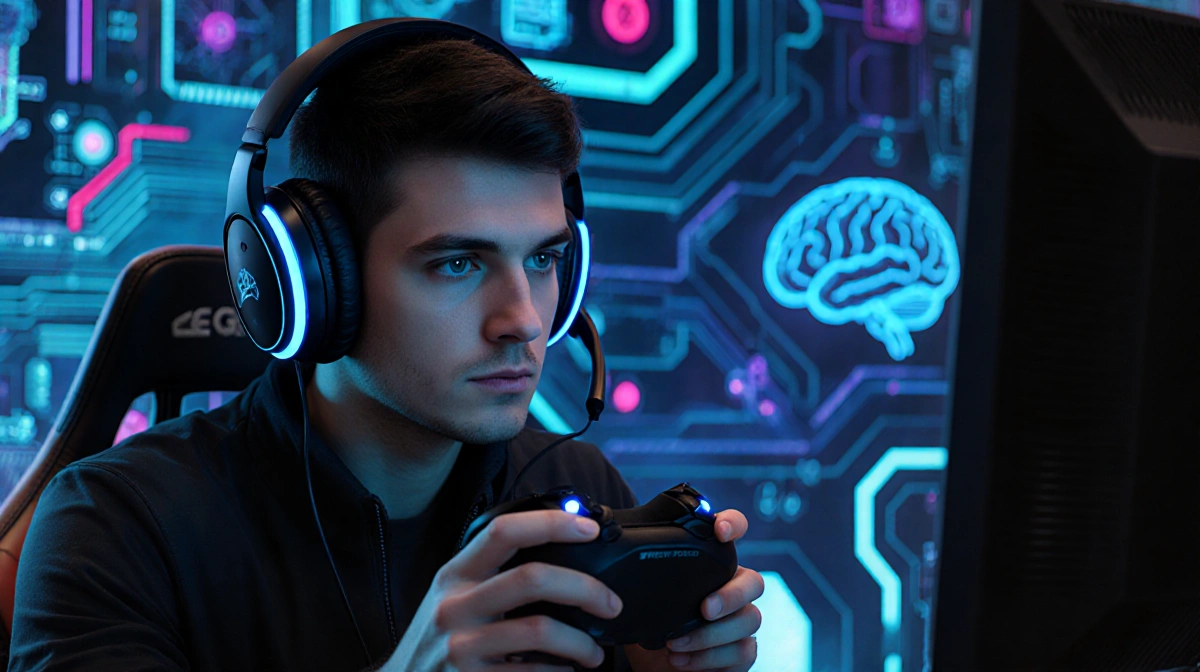
Neurable wants to turn the moments before a match into a data-driven warm-up. The Boston-based EEG startup has teamed with HP’s gaming label HyperX to embed brain-sensing fabric into an otherwise standard wireless headset. Slip it on, stare at drifting dots until they collapse into a single orb, and the accompanying Prime software claims to usher players into a calmer, more reactive state-no scalp-hugging diodes required.
How the “Priming” Process Works
Instead of multiple electrodes, the modified HyperX Cloud Alpha 2 Wireless relies only on conductive pads that circle the earlobes. A quick calibration presents dozens of floating dots on screen; users relax until the dots merge. Distractions or stress slow convergence, giving immediate feedback on mental clutter.

- 43 seconds: average time recorded by Natalie A. Brooks during a CES 2026 demo
- Up to 4 minutes: reported duration for fatigued or anxious subjects
- Zero extra hardware: software runs on the same PC launching the game
Once the orb forms, the software signals the headset to store the user’s “primed” EEG signature. Players then launch their title of choice while the band continues logging focus dips, but no further on-screen prompts appear unless the user chooses to re-prime.
Benchmarks From a Small, Early Study
Neurable’s research lead, Dr. Alicia Howell-Munson, shared results gathered from 25 volunteers split into three groups:
| Group | AimLabs Accuracy Jump | Reaction-Time Delta |
|---|---|---|
| Collegiate esports athletes (13) | +2.9% | −38 ms |
| Casual FPS players (7) | +1.8% | −39 ms |
| FPS newcomers (5) | +0.7% | −12 ms |
She cautioned that the sample is modest and that performance can fluctuate daily, yet every millisecond matters in ranked ladders. Subjects ran three AimLabs tasks-static reflex, strafe track, and grid-shot-before and after a single priming cycle.
Fighting-game testers were also monitored, though metrics are harder to quantify; participants merely reported “feeling crisper” on combo timing.
What It Feels Like in Practice
Natalie A. Brooks tested the rig at CES. A baseline AimLabs run delivered 89% accuracy. After priming, the score slipped slightly but accuracy climbed to 92% while average reaction time shrank from 485 ms to 447 ms. The headset never vibrated or beeped; the only cue was the on-screen orb.
Foam cups swapped for fabric EEG pads did not alter weight noticeably. Pairing was automatic over the 2.4 GHz dongle, and battery life stayed within HyperX’s quoted up to 120 hours because the low-power EEG board draws micro-amps.
Price, Release Window, and Unknowns
Adam Molnar, Neurable co-founder, said a commercial HyperX model will ship “later this year,” but neither partner has disclosed:
- Final retail price
- Whether Prime software incurs a subscription
- Possible console support (current demo is Windows-only)
Past Neurable collaborations with Master & Dynamics landed in the $349-$499 bracket, suggesting a premium tier. The marketing slant clearly targets players who “care more about their K/D ratio than anything else,” according to promo sheets shown to News Of Fort Worth.
Neurable insists the device is not a medical tool nor does it physically rewire synapses. It simply offers faster biofeedback than traditional breathing exercises, letting motivated gamers rehearse focus much like athletes rehearse form.
Key Takeaways
- Measurable gains appear inside a single practice session, but long-term benefits need larger studies.
- Hardware overhead is minimal: same headset, new fabric, and one extra USB receiver chip.
- Esports squads seeking marginal improvements now have an affordable, non-invasive metric to add to scrim reviews.
If your mind drifts, the dots stop moving; if you lock in, they merge, and your next flick shot might land 38 ms sooner. For players chasing rank, that could be the difference between a whiff and a highlight reel.