
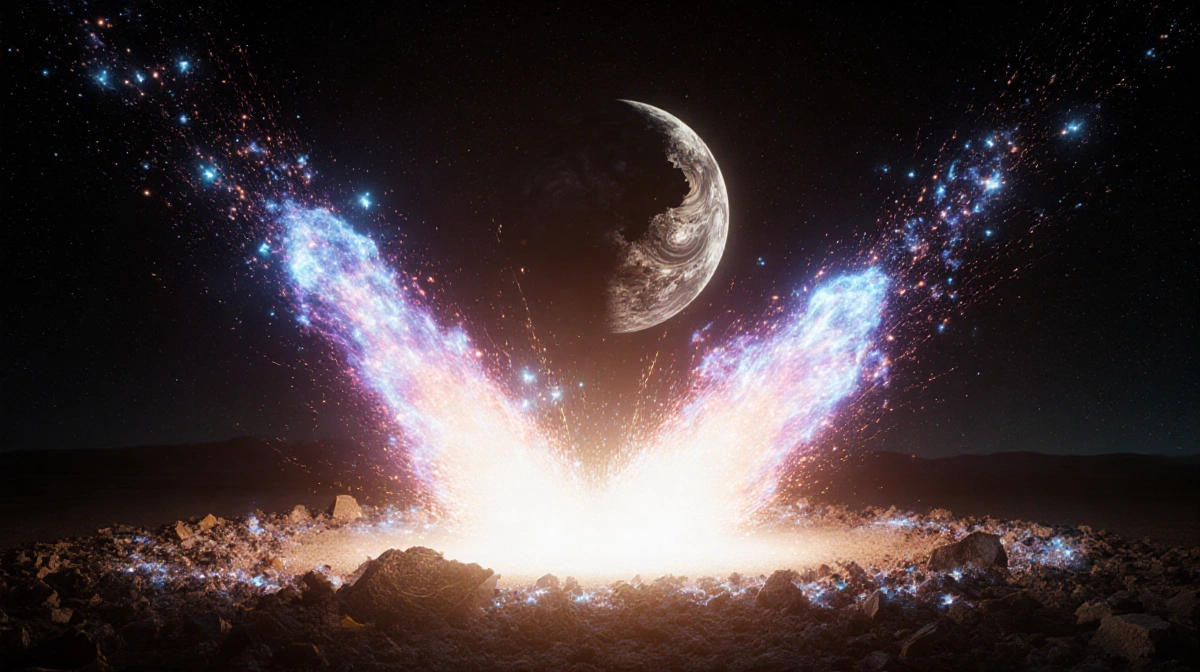

The Center for High Angular Resolution Astronomy (CHARA Array) at Georgia State University has captured the sharpest pictures ever taken of newborn nova explosions, revealing violent shock waves and delayed ejections that challenge the idea of a single, simple blast.
At a Glance
- CHARA Array imaged two 2021 novae within days of detonation using near-infrared interferometry
- V1674 Herculis shot out twin jets and triggered gamma-ray shock waves in under four days
- V1405 Cassiopeiae kept its outer layer bottled up for weeks before sudden expulsion
- Why it matters: These snapshots turn stellar explosions into real-time laboratories for studying how shock waves and particle acceleration shape our galaxy
Twin Jets in record time
On 12 June 2021 the nova V1674 Herculis flared so fast it reached peak brightness in <16 hours and faded within days. CHARA swiveled its six telescopes and, 2.2 days post-discovery, saw an hourglass-shaped bloom: two ejecta jets-one northwest, one southeast-flanked by an elliptical ring almost perpendicular to them.
A second image at 3.2 days showed the jets lengthening. Simultaneously, NASA’s Fermi telescope logged a surge of gigaelectronvolt gamma rays. Spectra taken at the same time revealed a new, faster hydrogen component racing outward at 5,500 km/s, overtaking earlier gas at 3,800 km/s. The collision of the two streams forged the gamma-ray shock wave.
The case of the missing shell
V1405 Cassiopeiae, discovered 18 March 2021, behaved in the opposite fashion. It took 53 days to top out and stayed bright for roughly 200 days. CHARA watched three times during rise and early decline.
- First two visits: only a pinpoint source, diameter 0.99 milliarcseconds (radius ~0.85 au)
- Expected shell if all gas had blown outward: 23-46 au radius-25-50 times larger
The telescope saw no extended emission, proving the hydrogen-rich envelope stayed wrapped around the binary instead of being flung away.
Delayed detonation
Weeks later the scene changed. By the third epoch the central source supplied just half the total light; the rest poured from a growing halo. A broad spectral component appeared at 2,100 km/s, signalling the delayed expulsion of the outer layer and fresh shock waves. Fermi again recorded high-energy emission.
Novae as cosmic labs
More than 20 novae have now been caught emitting gamma rays. The CHARA images give direct proof that multiple, interacting ejecta-not a single spherical shell-produce these high-energy flashes. Slowly evolving novae like V1405 may let the orbital motion of the white-dwarf pair push out the lingering common envelope, offering a rare glimpse of stellar couples so close they share outer layers-a configuration thought to occur in over 10 percent of stars.
Key takeaways
- Near-infrared interferometry can resolve infant nova structures within hours
- Fast novae can launch asymmetrical jets and gamma-ray shocks in under four days
- Slow novae may bottle up their outer layers for weeks before sudden release
- These events double as natural shock laboratories for studying particle acceleration in space