


At a Glance
- China hosts 200+ companies developing humanoids, dwarfing the US total of 16
- Unitree’s G1 sells for $13,500-about one-tenth the price of typical US models
- Bank of America forecasts 10 million humanoids shipped annually by 2035, with 302 million in China by 2050
- Why it matters: Cheaper, faster production could let China deploy humanoids at global scale before Western rivals
China’s convention centers already look like tomorrow’s factory floor. At the World Artificial Intelligence Conference in Shanghai, 4-foot humanoids box, dance, and ferry boxes while handlers clutch hidden controllers. The spectacle is part trade show, part proving ground for a national push to dominate robotics.
Hangzhou-based Unitree leads the charge. Its robots sprint, kick, and back-flip while costing tens of thousands of dollars-a tenth of US equivalents. The startup, reportedly targeting a $7 billion IPO, sold 24,000 quadrupeds in 2023, ten times Boston Dynamics’ volume, according to SemiAnalysis. Prices start at $1,600 for its Go2 robot dog; its newest humanoid, the G1, sells for $13,500 to academics, with a stripped-down R1 model at $5,700.
Unitree CEO Wang Xingxing traces the obsession to a college prototype built for $28. After a viral video of a low-cost quadruped in 2015, he founded Unitree in 2016 and released the Laikago robot dog for $25,000, undercutting Boston Dynamics’ $75,000 Spot. Rapid iterations followed, exploiting China’s dense supply chains; a $8,000 Go2 contains just $3,272 in parts.
Wang’s next target is human labor. In a July keynote he pledged robots that “serve tea, work in factories, or perform arts,” predicting a robotic “ChatGPT moment” within one to five years when machines tidy unfamiliar rooms on voice command.
The Beijing Academy of Artificial Intelligence pursues the same milestone. Engineers teleoperate arms to pour tea or sweep beans, recording every motion to train an open-source Robobrain 2.0 model that fuses language and spatial reasoning. When told, “I’m hungry, make me a burger,” the system commands robot arms to stack lettuce and meat.
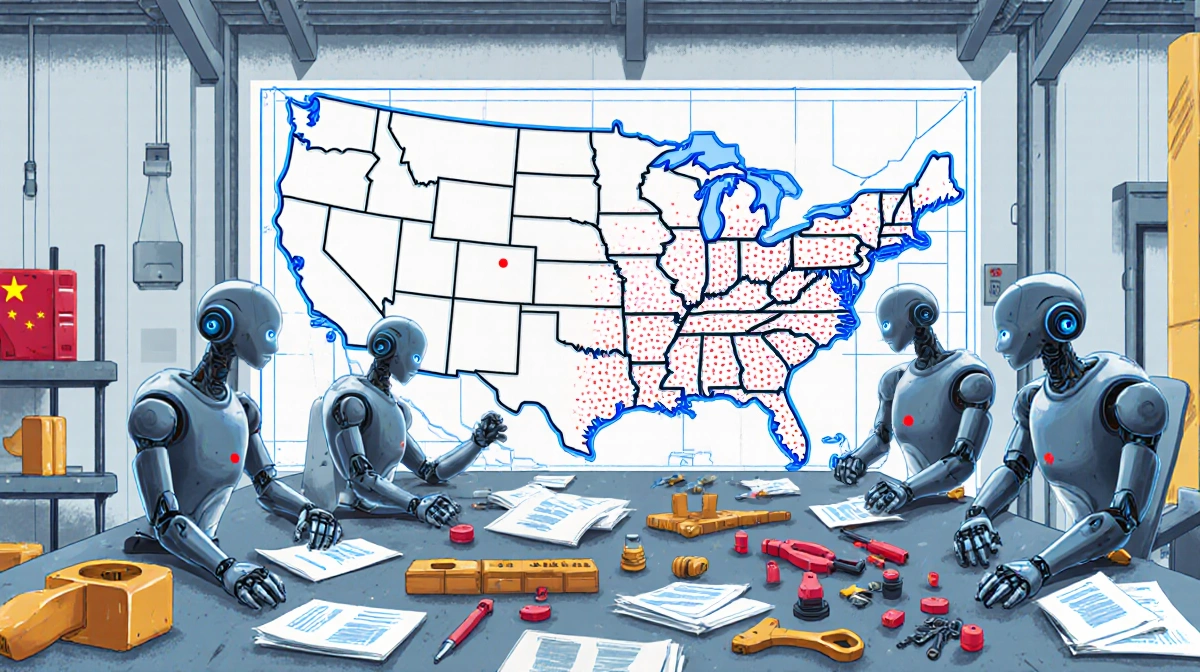
Data volume remains the bottleneck. No consensus exists on how much teleoperation or what sensor mixes yield human-level dexterity. Still, China’s scale advantage is clear: 200+ firms are building humanoids, prompting government warnings of overcapacity. The US hosts roughly 16.
Morgan Stanley projects one billion humanoids worldwide by 2050, with 302 million in China versus 78 million in the US. Bank of America sees annual shipments hitting 10 million by 2035. Amazon already tests Agility humanoids and, per leaked memos, expects them to replace “a significant number” of warehouse workers.
Speed matters as much as price. Sunday Robotics CEO Tony Zhao, whose California startup competes in the space, says, “The iteration speed, the US is losing there. And honestly I don’t know how we can win.” He hired Chinese supply-chain veterans, arguing, “The only way we can beat Chinese companies is to build a China team.”
Policy may be the next battleground. Agility co-founder Jonathan Hurst urges Washington to fund domestic automation and offer tax incentives for robot deployments, mirroring Beijing’s state subsidies. “We have to be very smart about automation,” he says. “It is the only way.”
For now, humans still fold shirts faster. In a Beijing hotel, a concierge named Stephen pressed and returned a guest’s shirt in hours-proof that, even in China, robots have not yet won.