
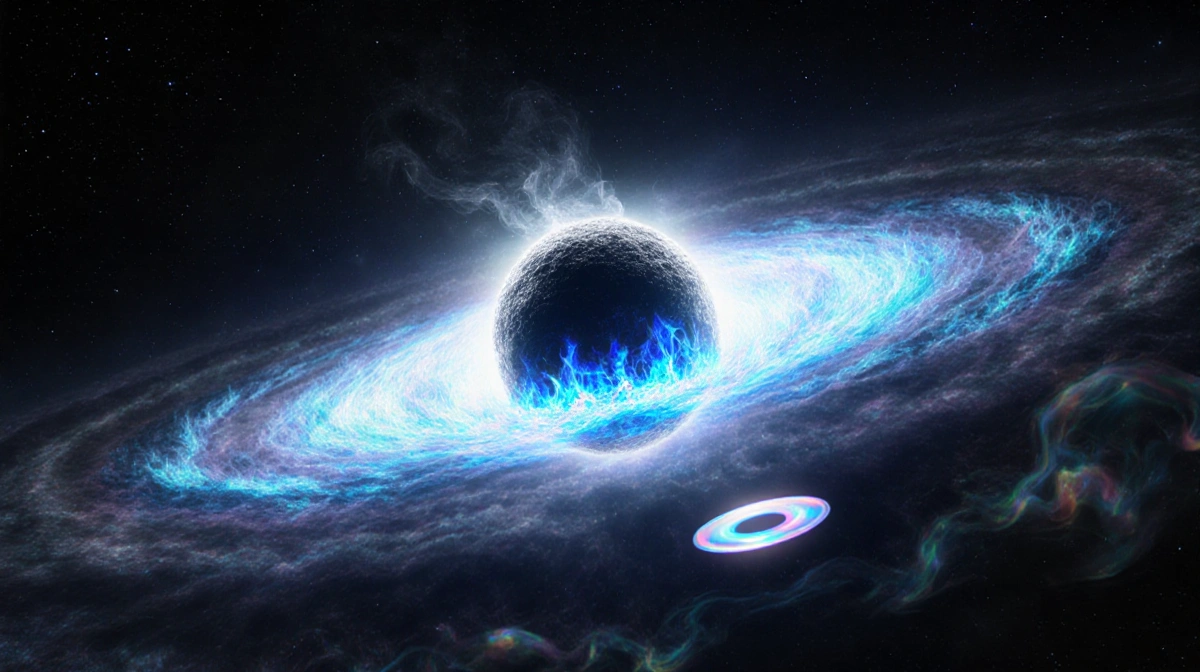

A white dwarf 730 light-years from Earth is emitting a glowing bow shock that defies every known law of stellar physics, researchers report in the journal Nature Astronomy.
The deceased star, catalogued as RXJ0528+2838, no longer fuses fuel and shows no surrounding disc of material-yet it has expelled matter for at least 1,000 years, producing a colorful ribbon of red, green, and blue gases rippling through space.
At a Glance
- A disc-less white dwarf has created a bright bow shock without any visible source of outflow
- Observations from ESO’s Very Large Telescope rule out the usual accretion-disc mechanism
- A hidden magnetic field might channel gas from the companion star, but even that fails to explain the thousand-year persistence
- Why it matters: The finding upends textbook models of how dead stars interact with companions and surrounding gas
Cosmic Head-Scratcher
White dwarfs are stellar corpses: after Sun-like stars exhaust their fuel, they shed outer layers and leave behind a hot, Earth-sized core that slowly cools. RXJ0528+2838 shares the stage with a Sun-like companion, making the duo a binary system. In thousands of similar binaries, gas from the companion spirals into a disc around the dwarf and eventually spits jets or winds into space. That expelled material ploughs into the interstellar medium, carving out a curved bow shock ahead of the system.
The new data reveal exactly such a shock, yet no disc shows up in any wavelength. “We found something never seen before and, more importantly, entirely unexpected,” said Simone Scaringi, associate professor at Durham University and co-lead author. “The surprise that a supposedly quiet, discless system could drive such a spectacular nebula was one of those rare ‘wow’ moments.”
What the Telescope Saw
Derrick M. Collins reported for News Of Fort Worth that the Very Large Telescope’s MUSE instrument captured the bow shock in high resolution. The team mapped the structure’s shape, size, and spectrum, confirming its origin at the binary. Key findings include:
- A curved, comet-like arc that stretches several light-days ahead of the stars
- Emission lines of hydrogen, oxygen, and nitrogen glowing in visible red, green, and blue-classic tracers of shock-heated gas
- A thickness and brightness that imply continuous injection of material for centuries
“Our observations reveal a powerful outflow that, according to our current understanding, shouldn’t be there,” said Krystian Ilkiewicz, postdoctoral researcher at the Nicolaus Copernicus Astronomical Center in Warsaw and co-lead of the study.
Why No Disc Matters
Without a disc, there is no reservoir to feed a wind, jet, or radiation pressure strong enough to push gas outward. Previous surveys of disc-less white dwarfs never detected bow shocks. The researchers checked archived images and spectra spanning two decades; none hint at a disc forming or reappearing around RXJ0528+2838.
The companion star itself is not shedding enough mass to account for the shock either. Its stellar wind is typical for a Sun-like star, orders of magnitude too weak to sculpt the observed arc.
The Magnetic Field Lifeline
One plausible, if incomplete, explanation is a strong magnetic field rooted in the white dwarf. Fields of a few million gauss-roughly a trillion times stronger than Earth’s-could funnel gas straight onto the dwarf’s surface, bypassing the need for a disc. Some of that material could then be flung outward along open field lines, powering a tenuous but persistent outflow.
But there’s a catch: magnetic channelling would only remain efficient for a few hundred years at most, far short of the millennium-long timescale implied by the shock’s size. The team calculates that the field would need to be regenerated or somehow sustained, a process with no clear mechanism in a dead star.
Rewriting the Playbook
Whatever the ultimate driver, the discovery forces astronomers to rethink how mass and energy circulate in close binary remnants. Standard models assume that discs are mandatory for energetic outflows; RXJ0528+2838 proves otherwise.
“This discovery challenges the standard picture of how matter moves and interacts in these extreme binary systems,” Ilkiewicz said. “Our finding shows that even without a disc, these systems can drive powerful outflows, revealing a mechanism we do not yet understand.”
What Comes Next
The team has been awarded follow-up time on both the Very Large Telescope and the Chandra X-ray Observatory. They plan to:
- Search for high-energy emission that could betray magnetic activity
- Map the velocity of gas in the bow shock to pin down the mass-loss rate
- Hunt for similar bow shocks around other disc-less white dwarfs in the latest Gaia catalogue
If more examples emerge, theorists will have the statistical leverage needed to test new physics-perhaps involving magnetically driven winds, fossil fusion flashes, or even exotic particle interactions inside the dead star’s core.
For now, RXJ0528+2838 remains a solitary enigma: a quiet stellar ember that refuses to lie still, lighting up its corner of the galaxy with a colourful, thousand-year glow no one can yet explain.