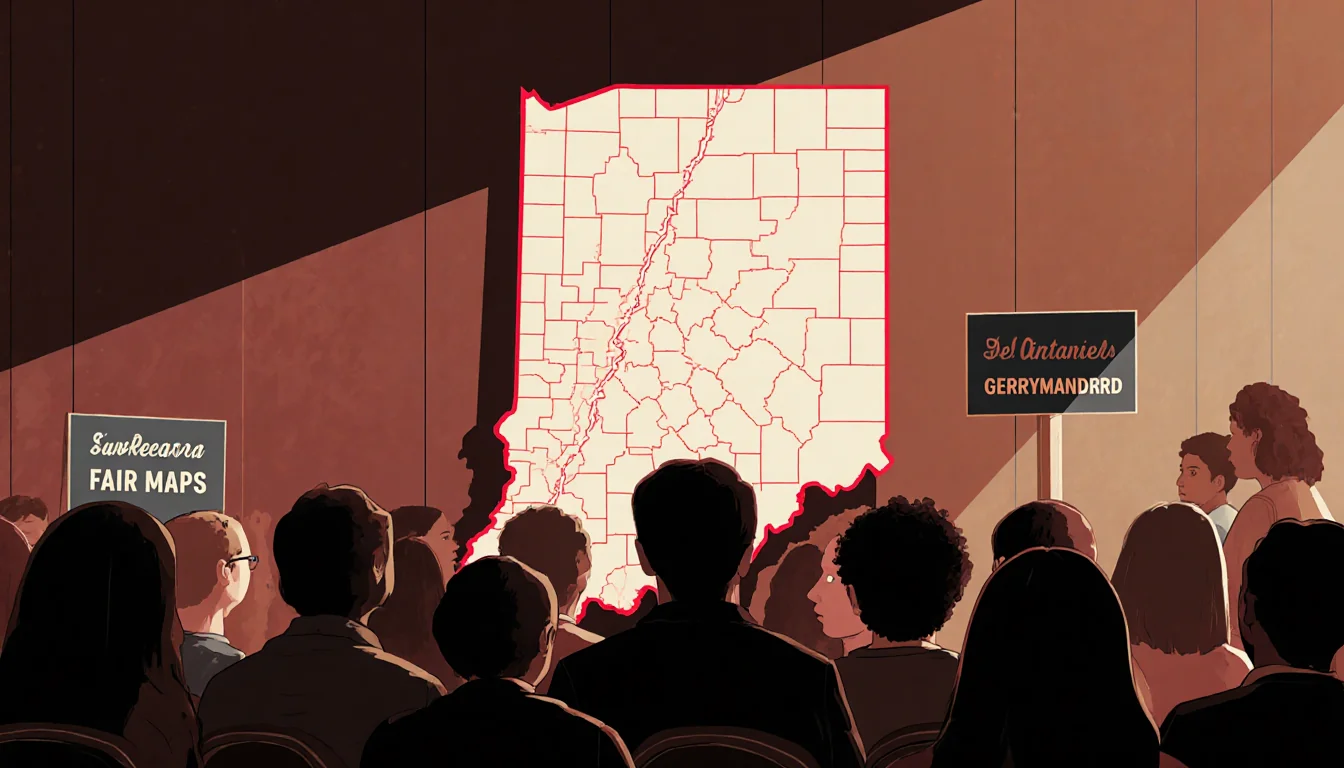

In a move that could reshape the political landscape of the Midwest, Indiana lawmakers recently rejected a Trump‑backed congressional map that would have given Republicans all nine of the state’s seats. The decision comes amid a wave of mid‑decade redistricting across the country, raising questions about what it means for a map to be “fair.”
The Clash Over “Fair” Maps
Four years after Indiana adopted new U.S. House districts, Republican leaders praised them as fair maps that reflected the state’s communities. Governor Mike Braun has now urged lawmakers to “vote for fair maps” as he pushes to redraw boundaries in a way that would shift more seats toward Republicans. The definition of fairness, however, has shifted.
Mid‑decade redistricting, driven by former President Donald Trump, has seen both parties in several states adopt aggressive gerrymandering tactics. Each side argues that the maps are fair because other states have used similar methods, and that the changes are necessary to preserve a partisan balance in the House that mirrors the national political divide.
The new approach treats the House like the Senate, where members reflect a state’s majority party, rather than the more diverse patchwork it has traditionally represented. Critics warn that the shift could reduce power for minority communities, diminish attention to certain issues, and limit the distinct voices that have historically been heard in Washington.
Voices of Concern
Senator Rand Paul of Kentucky warned that unchecked gerrymandering could send the country down a perilous path. “I think that it’s going to lead to more civil tension and possibly more violence in our country,” he said Sunday on NBC’s Meet the Press.
Retired English professor Wayne Fields, an expert on political rhetoric, called the trend a “fundamental undermining of a key democratic condition.” He added, “The House is supposed to represent the people. We gain an awful lot by having particular parts of the population heard.”
Rebekah Caruthers, who leads the nonprofit Fair Elections Center, argued for compact districts that allow communities of interest to elect the representatives of their choice, regardless of national balance. “Gerrymandering districts to be dominated by a single party results in an unfair disenfranchisement of some voters,” she said. “Ultimately, this isn’t going to be good for democracy. We need some type of détente.”
The Indiana Map Debate

Indiana’s current U.S. House delegation consists of seven Republicans and two Democrats—one representing Indianapolis and the other a suburban Chicago district in the state’s north‑western corner. Lawmakers considered a Trump‑backed plan that would have split Indianapolis among four Republican‑leaning districts and merged the Chicago suburbs with rural Republican areas.
Opponents walked the Capitol halls in protest, carrying signs that read “I stand for fair maps!” Talk radio host Ethan Hatcher, who says he votes for Republicans and Libertarians, denounced the plan as “a blatant power grab” that “compromises the principles of our Founding Fathers” by fracturing Democratic strongholds to dilute urban voters. “It’s a calculated assault on fair representation,” Hatcher told a state Senate committee.
Others argued that it would be fair for Indiana Republicans to hold all nine seats because Trump won the “solidly Republican state” by nearly three‑fifths of the vote. Resident Tracy Kissel said at a committee hearing, “Our current 7‑2 congressional delegation doesn’t fully capture that strength. We can create fairer, more competitive districts that align with how Hoosiers vote.”
When senators defeated a map designed to deliver a 9‑0 delegation for Republicans, Braun lamented that they had missed an “opportunity to protect Hoosiers with fair maps.”
The National Context
The U.S. House already appears politically fair on a national scale. An Associated Press analysis of the 2024 elections found a 220‑215 Republican majority over Democrats that almost perfectly aligns with the share of the vote the two parties received in districts across the country.
However, that overall balance masks an imbalance that exists in many states. Before this year’s redistricting, the number of states with congressional districts tilted toward one party or another was higher than at any point in at least a decade, the AP analysis found.
Political science professor Kent Syler of Middle Tennessee State University said the partisan divisions have contributed to a “cutthroat political environment” that “drives the parties to extreme measures.” He noted that Republicans hold 88% of congressional seats in Tennessee, while Democrats have an equivalent in Maryland. “Fairer redistricting would give people more of a feeling that they have a voice,” Syler said.
Redistricting’s Impact on Communities
Under the Constitution, the Senate has two members from each state, while the House has 435 seats divided among states based on population, with each state guaranteed at least one representative. In the current Congress, California has the most seats at 52, followed by Texas with 38.
Senators are elected statewide and are almost always political pairs of one party or another. Pennsylvania and Wisconsin are the only states now with both a Democrat and a Republican in the Senate. Maine and Vermont each have one independent and one senator affiliated with a political party.
House districts, with an average of 761,000 residents based on the 2020 census, are more likely to reflect varying partisan preferences of urban or rural voters, as well as different racial, ethnic and economic groups.
This year’s redistricting is diminishing those locally unique districts. In California, voters in several rural counties that backed Trump were separated from similar rural areas and attached to a reshaped congressional district containing liberal coastal communities. In Missouri, Democratic‑leaning voters in Kansas City were split from one main district into three, with each revised district stretching deep into rural Republican areas.
Some residents complained their voices are getting drowned out. Govs. Gavin Newsom (D‑Calif.) and Mike Kehoe (R‑Mo.) defended the gerrymandering as a means of countering other states and amplifying the voices of those aligned with the state’s majority.
Key Takeaways
- Indiana’s Senate rejected a Trump‑backed map that would have given Republicans all nine House seats.
- Mid‑decade redistricting across the country has seen both parties adopt aggressive gerrymandering tactics.
- Critics argue the new approach treats the House like the Senate, reducing minority representation and distinct voices.
The debate in Indiana reflects a broader national conversation about what constitutes a fair congressional map and how partisan interests shape the political map of the United States.
Closing
As other states, including Texas, California, Missouri, North Carolina and Ohio, have already redrawn their congressional districts, Indiana lawmakers face a pivotal decision. The outcome will influence not only the state’s representation but also the broader national discourse on democracy, representation and the future of the U.S. House.