
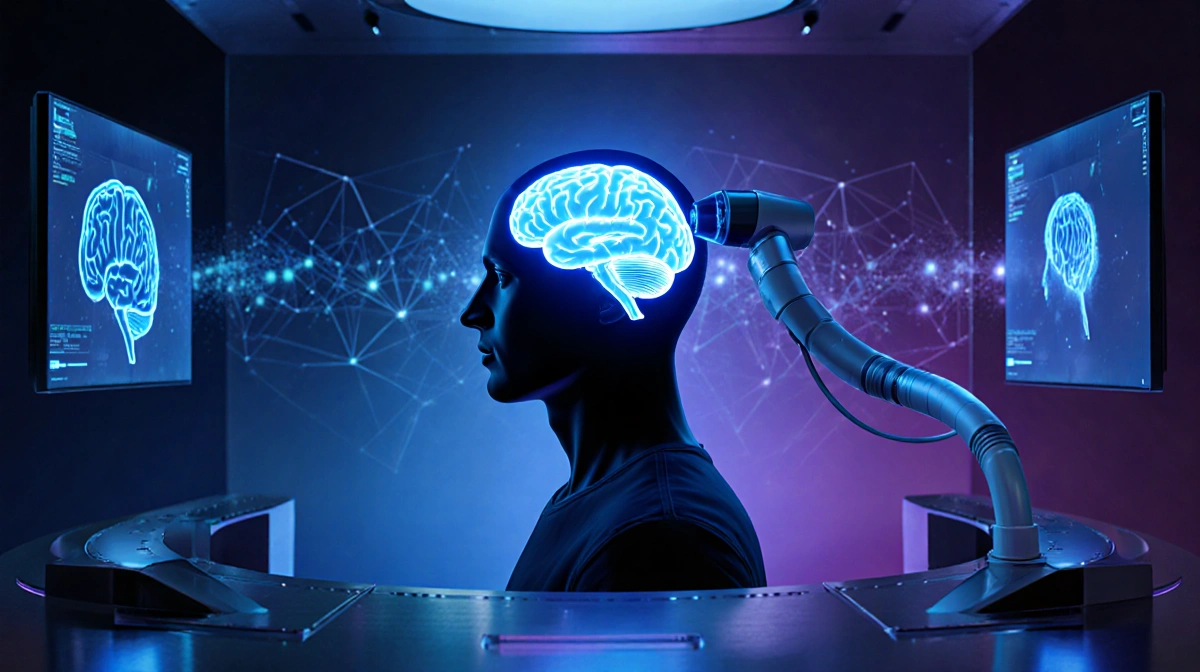

OpenAI is bankrolling a new company that wants to let people control computers with their minds-without drilling into their skulls.
At a Glance
- OpenAI has invested in Merge Labs, a startup co-founded by its own CEO Sam Altman, to build ultrasound brain-computer interfaces
- The venture has raised $252 million from OpenAI, Bain Capital, Valve’s Gabe Newell, and others
- Merge will use molecules and ultrasound instead of implanted electrodes, positioning itself as a less-invasive rival to Neuralink
- Why it matters: The move could accelerate non-invasive brain tech that lets paralyzed users-and eventually healthy consumers-interact with devices at the speed of thought
The alliance was announced Thursday and signals OpenAI’s first major step into neurotechnology. Merge Labs, spun out of the nonprofit Forest Neurotech, will develop hardware that sits on or near the scalp, eliminating the need for brain surgery that competitors such as Neuralink require.
Inside the $252 Million Bet
Altman, who previously backed Elon Musk’s Neuralink, now heads a direct competitor. While Neuralink has raised $1.3 billion and placed coin-size chips inside at least 12 volunteers, Merge is pursuing a radically different path.
Key funders and their roles:
- OpenAI – strategic partner providing AI models to interpret noisy brain signals
- Bain Capital – lead financial backer
- Gabe Newell – individual investor and Valve co-founder
- Forest Neurotech – nonprofit parent that will continue parallel research
The company’s website states: “We’re developing entirely new technologies that connect with neurons using molecules instead of electrodes, transmit and receive information using deep-reaching modalities like ultrasound, and avoid implants into brain tissue.”
How Ultrasound Reads the Mind

Traditional brain-computer interfaces, including those from Neuralink and Synchron, record the brain’s electrical chatter by placing electrodes either on the cortex or inside a nearby blood vessel. Merge’s system, by contrast, listens for changes in blood flow induced by neural activity-an indirect but potentially safer signal.
Early safety trials of a miniaturized Forest ultrasound device are already under way in the United Kingdom. Forest will remain a nonprofit and continue to collaborate with Merge, according to a blog post from its parent organization.
AI as the Interpreter
OpenAI’s contribution goes beyond cash. The company will build “scientific foundation models” that learn to decode intent from low-bandwidth, noisy ultrasound data. The announcement claims these models will “adapt to individuals and operate reliably with limited and noisy signals,” a challenge that has stumped earlier non-invasive approaches.
Synchron, which has raised $345 million, is pursuing a similar AI strategy in partnership with Nvidia. Both efforts aim to move beyond moving cursors and robotic arms toward more complex tasks such as speech synthesis or even direct thought-to-text conversion.
The Founding Team
In addition to Altman, Merge’s co-founders include:
- Mikhail Shapiro – Caltech professor and ultrasound imaging pioneer
- Tyson Aflalo – neuroscience researcher
- Sumner Norman – former Forest Neurotech scientist
- Alex Blania – tech entrepreneur
- Sandro Herbig – product engineer
The company is actively hiring across engineering, neuroscience, and AI roles.
What Comes Next
Merge has not disclosed which applications it will pursue first, but Forest Neurotech’s published research focuses on depression, anxiety, and traumatic brain injury. Analysts told News Of Fort Worth the startup is likely to target medical markets before expanding to consumer use.
If successful, Merge’s non-invasive approach could widen the pool of potential users from thousands of paralyzed patients to millions of healthy consumers seeking faster interaction with phones, computers, and eventually augmented-reality glasses.
Key Takeaways
- OpenAI’s investment ties its AI models to a hardware platform that could one day deliver neural data at scale
- Ultrasound avoids the surgical risks that have slowed adoption of rival implants
- Competition is intensifying: at least 22 people already have either a Neuralink or Synchron device inside their heads
- Regulatory approval for non-invasive brain tech is expected to move faster than implanted alternatives, potentially letting Merge reach market sooner despite its later start