

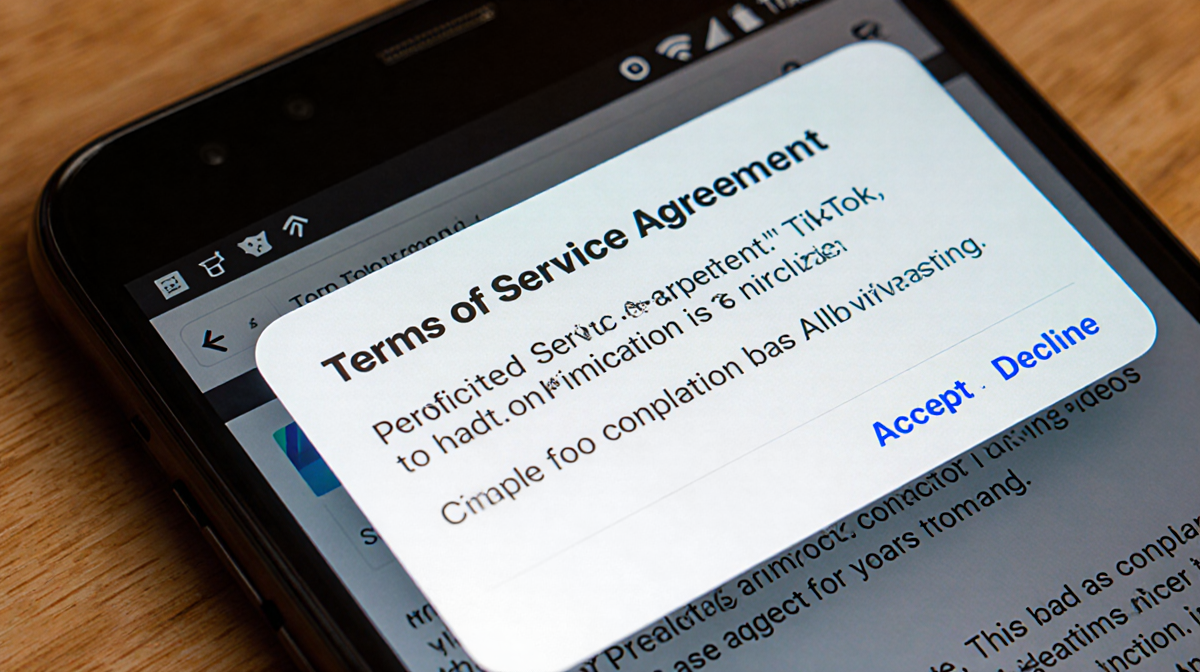
TikTok has just announced a sweeping change to its privacy terms after its ownership was shifted to a new U.S.-based entity. The change was prompted by a U.S. government mandate that required the app to move away from Chinese control. Users now see a pop-up that asks them to accept the new terms before they can continue scrolling.
At a Glance
- A pop-up asks users to accept new terms before scrolling.
- TikTok is now owned by TikTok USDS Joint Venture LLC, an American-majority entity that includes Oracle.
- The new privacy policy adds precise GPS location tracking for U.S. users.
- AI interactions and ad-network data collection are now explicitly recorded.
- Why it matters: These changes shift how user data is collected, stored, and used for advertising across the internet.
New US Ownership
After the U.S. government mandated a change in control, TikTok is now operated by TikTok USDS Joint Venture LLC. The joint venture is a U.S.-majority corporate entity that includes investors such as Oracle. The shift was intended to satisfy regulatory concerns about data security and foreign influence. While the app’s core features remain unchanged, the ownership change allows the platform to continue operating in the United States.
The move to a U.S.-majority entity was driven by concerns over data access by foreign governments. By bringing ownership under an American corporate structure, TikTok aims to reassure regulators and users that data is handled domestically.
Pop-Up and User Consent
When users open the app today, they are greeted with a pop-up that requires acceptance of the updated terms of service and privacy policy. The message appears before any content loads, making it difficult for users to skip or ignore. TikTok’s spokesperson for the new entity declined to comment on the specifics of the policy changes.
The pop-up appears immediately upon launching the app, making it the first interaction users have with the new terms. Because the screen blocks content, many users may simply tap Agree without reading the full text.
Precise Location Tracking
Under the old policy, TikTok collected only approximate location data derived from SIM card region or IP address. The new policy now allows the app to gather GPS-derived location data when users enable the device’s location services. This means the platform can record users’ exact whereabouts in real time. The policy also continues to collect approximate data for user-generated content that includes location tags.
Precise GPS data can enable location-based services such as nearby content suggestions, but also raises concerns about user privacy and potential misuse by third parties.
| Feature | Old Policy | New Policy |
|---|---|---|
| Precise GPS data | Not collected | Collected if location services enabled |
| Approximate location | Collected from SIM/IP | Still collected |
| Location in user content | Collected if added | Same, but with precise GPS if enabled |
AI Interaction Data
Previously, TikTok’s privacy policy did not mention data from AI tools. The updated policy explicitly states that any interaction with the platform’s AI interfaces-prompts, questions, files, and generated responses-will be recorded. Metadata such as when, where, and by whom the interaction occurred is also automatically uploaded. This expands the scope of data TikTok can store about users’ AI usage.
Storing AI prompts and outputs expands TikTok’s data set, potentially allowing the company to refine its recommendation algorithms based on AI usage patterns.
| Data Type | Old Policy | New Policy |
|---|---|---|
| AI prompts | Not mentioned | Collected |
| AI outputs | Not mentioned | Collected |
| Metadata (time, location, user) | Not mentioned | Collected |
Expanded Ad Network
TikTok’s new policy also expands how it uses collected data for advertising. In addition to in-app targeting, the platform can now leverage user data to serve more relevant ads on external sites and apps. The policy lists publishers as a new partner category, indicating that third-party publishers can supply additional data to TikTok’s ad ecosystem. This broadens the reach of TikTok’s advertising beyond its own platform.
The inclusion of publishers as partners indicates that TikTok will integrate third-party data into its ad targeting, potentially increasing the accuracy of cross-platform campaigns.
- In-app ads remain unchanged.
- Cross-site ads now use TikTok data.
- Publishers can supply data to TikTok.
- Advertisers can target users across the web.
What It Means for Users
For everyday users, the most noticeable change is the potential for more precise location tracking. This could affect the relevance of local ads and the accuracy of location-based content recommendations. The addition of AI interaction data means that every prompt or request made to TikTok’s AI tools is stored and could be used to refine future responses. Finally, the expanded ad network may result in seeing TikTok-powered ads on websites and apps outside of the TikTok app.
Location data may be shared with third-party advertisers.
AI interaction logs could be used to personalize content beyond the app.
Key Takeaways
- TikTok’s ownership now resides in a U.S. entity.
- The new privacy policy adds precise GPS tracking.
- AI interactions are now recorded and stored.
- Advertising data can be used beyond TikTok’s platform.
- The policy changes are part of a broader effort to comply with U.S. data privacy standards.
Policy Change Summary
| Change | Description |
|---|---|
| Ownership | Shift to TikTok USDS Joint Venture LLC (U.S. majority) |
| Location | GPS data collection enabled for U.S. users |
| AI | Prompts, outputs, and metadata now collected |
| Ads | Data used for cross-site advertising and publisher partnerships |