
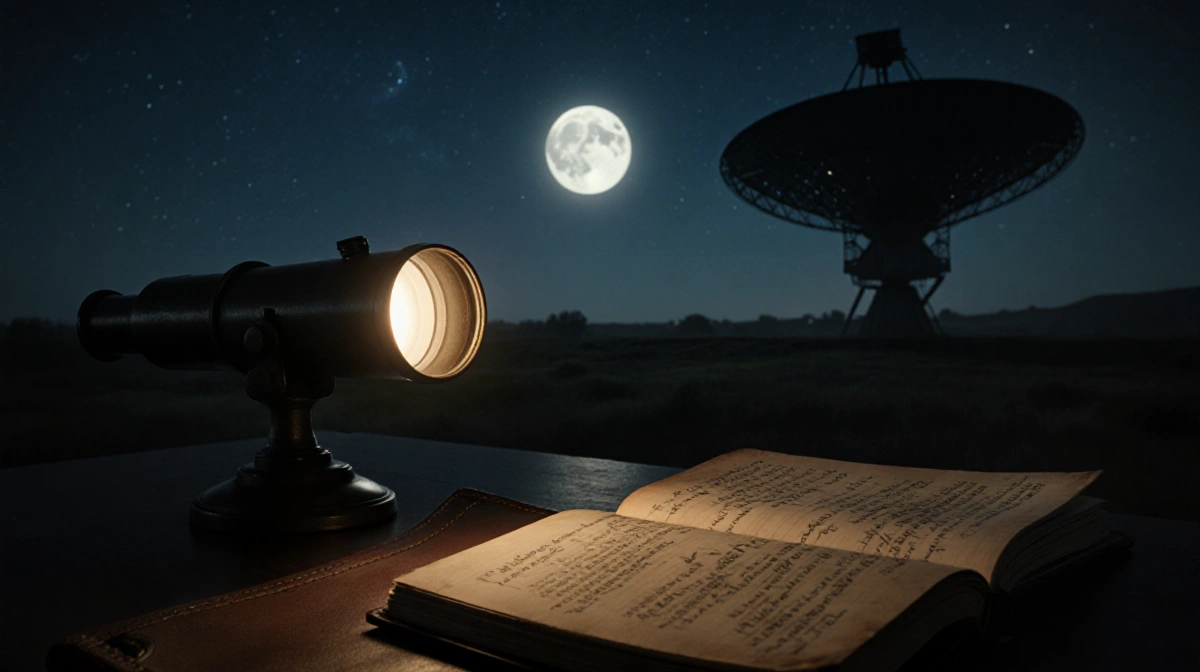

The hunt for alien technology has moved from science fiction to peer-reviewed journals. Researchers are now scouring decades-old sky photographs and Earth orbit for signs of objects that pre-date human spaceflight-and some claim they’ve already found anomalies that defy easy explanation.
At a Glance
- Archival photos taken before 1957 show unexplained satellite-like objects
- Scientists are developing new techniques to scan the solar system for alien artifacts
- Funding for dedicated missions remains elusive due to scientific stigma
- Why it matters: If confirmed, such discoveries would reshape humanity’s place in the universe
The Pre-Sputnik Puzzle
Beatriz Villarroel, an assistant professor of astronomy at the Nordic Institute for Theoretical Physics, leads the Vanishing & Appearing Sources during a Century of Observations project (VASCO). Her team digitized thousands of glass-plate images captured before the launch of Sputnik in 1957. The goal was to spot any stars that disappeared over decades, but the plates delivered a different surprise.
“That’s when I realized this is actually a fantastic archive, not for searching for vanishing stars, but for looking for artifacts,” Villarroel says.
The group logged transient pinpoints of light that mimic artificial satellites, yet appear decades before any human craft left Earth. In 2021 they reported roughly 100 such objects. Critics argue the flashes could stem from:
- Camera flaws
- Meteors
- Nuclear-test debris
Villarroel counters that the sightings cluster in ways instrumental noise rarely does. A definitive answer, she says, would require sending a probe into geosynchronous orbit-about 22,000 miles above Earth-to photograph whatever reflective fragments might still circle the planet.
“There’s so much taboo that nobody’s ever going to take such results seriously until you bring down such a probe,” she adds.
Old Idea, New Tools
Adam Frank, a professor of astrophysics at the University of Rochester, notes that searching for alien hardware has deep roots. “In the history of technosignatures, the possibility that there could be artifacts in the solar system has been around for a long time,” he says.
What’s changed is the toolkit:
- Machine-learning algorithms sift through petabytes of sky-survey data
- High-resolution interplanetary cameras can now resolve objects smaller than a meter
- Spectrometers look for alloys not found in nature
Still, the field wrestles with a credibility problem. Frank sees the pushback as healthy skepticism, yet concedes that stigma can choke funding streams and scare young researchers away from the topic.
Three Interstellar Visitors, Zero Smoking Guns

Since 2017 astronomers have confirmed three objects that originated outside the solar system:
- ‘Oumuamua – A tumbling, cigar-shaped body spotted by Hawaii’s Pan-STARRS telescope
- 2I/Borisov – A comet that briefly lit up skies in 2019
- IM2 – A small meteor that splashed into the Pacific in 2014
Public speculation has branded each as a possible alien craft, yet the scientific consensus favors natural origins. Even so, their very arrival has energized artifact hunters who argue that if these bodies made it here, older, engineered cousins could have arrived eons earlier and still lurk undetected.
What Would Count as Proof?
Because technosignatures could range from microscopic alloy flecks to city-sized motherships, researchers avoid rigid templates. Instead they rely on:
- Motion inconsistent with gravity alone
- Reflection spectra showing manufactured metals
- Heat signatures without natural explanation
The challenge is huge: Earth’s neighborhood spans billions of cubic kilometers. Current surveys cover only a fraction of that volume, and most telescopes are tuned for distant stars, not nearby slow-moving objects.
Funding Freeze
Villarroel doubts any federal space agency will underwrite a dedicated artifact-hunting mission soon. The topic sits in a scientific gray zone-too speculative for mainstream grants, too serious to ignore entirely.
Private ventures might fill the gap. Start-ups already design micro-satellites that could sweep geosynchronous orbit for oddities, but without government backing, large-scale searches remain stuck on drawing boards.
Frank believes the stigma will fade if evidence hardens. “We’ve been thinking about this for decades. We’ve been waiting for this to happen,” he says. “But being responsible scientists means holding to the highest standards of evidence and also not crying wolf.”
Next Steps for the Field
Villarroel’s team plans to widen their pre-1957 image sweep, incorporating plates from observatories in South America and Africa. Machine-learning models trained on known satellites will scan for similar tracks in the decades before Sputnik.
Meanwhile, Frank is part of a consortium drafting a white paper for NASA’s upcoming Decadal Survey, arguing that artifact searches deserve a modest slice of future astrophysics budgets. Even a $10 million annual program, they contend, could seed breakthrough instruments piggy-backed on conventional planetary missions.
For now, the best hope may lie in re-examining data already collected. Millions of sky photographs, radar logs, and infrared scans sit in archives, their anomalies never cataloged. Systematically mining those records costs a fraction of launching new hardware-and could, in theory, yield tomorrow’s headline.
Key Takeaways
- Pre-space age photos reveal mysterious satellite-like objects, hinting at possible alien artifacts
- Scientific stigma and tight budgets keep dedicated missions grounded
- New search tools, from AI to miniature probes, could accelerate discovery
- A single confirmed artifact would reshape biology, technology, and philosophy overnight
Until funding catches up with curiosity, teams like VASCO will keep combing the past, squinting at century-old negatives for glints of something that never belonged to Earth-or to humanity.