

At a Glance
- All You Need Is Kill anime film pivots to Rita instead of Keiji for the first time in franchise history
- Character designer Izumi Murakami crafts pastel-meets-scribbly visuals to smooth 3DCG integration
- Director Kenichiro Akimoto stakes his debut on showcasing “something beautiful” inside dystopian war
- Why it matters: Long-time fans get a fresh lens on a story they thought they knew by heart
Studio 4°C’s new anime adaptation of All You Need Is Kill lands in Japanese theaters on January 16, 2026, and it arrives with a twist no previous version has attempted: the narrative now follows Rita, the battle-hardened heroine, rather than the foot-soldier Keiji. The switch-up marks the third adaptation of Hiroshi Sakurazaka’s 2003 novel, after Takeshi Obata’s manga and the 2014 Hollywood film Edge of Tomorrow.
A Director’s Debut Born of “Perfect Timing”
Kenichiro Akimoto steps into the director’s chair for the first time after years of CG work on Berserk: The Golden Age Arc and Children of the Sea. He told News Of Fort Worth that the project crystallized when Warner Bros. pitched an animation proposal at the exact moment Studio 4°C president Eiko Tanaka asked him to helm a feature.
> “I had already been talking with our president about possibly helming a project. And at the same time, Warner Bros. put together a proposal for an All You Need Is Kill animation project,” Akimoto said. “It just happened to all work together as perfect timing.”
The novel’s time-loop premise-Keiji relives the day of his death until he and Rita break the cycle-has always centered on trauma, memory, and identity. Akimoto saw an opportunity to re-examine those themes through Rita’s eyes, arguing that a new angle could justify yet another adaptation of what he calls a “complete and very perfect” source text.
Visual Alchemy: Flat Characters Meet 3D Chaos
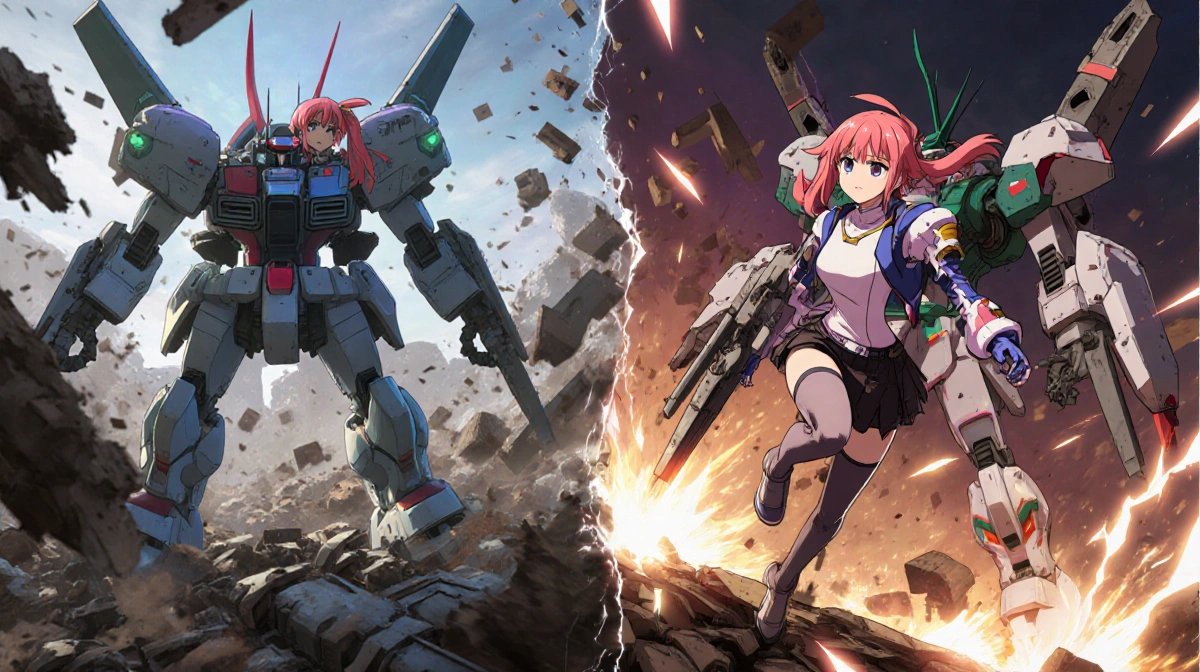
Studio 4°C’s signature 3DCG often divides anime fans, so Akimoto and first-time character designer Izumi Murakami set out to bridge the gap. Early Rita sketches leaned photorealistic, but Murakami steadily flattened the forms until they felt like hand-drawn decals sliding through textured mech battlefields.
> “If the characters are too realistic, then the contrast would be too abrupt,” Akimoto explained. “I wanted to challenge myself into creating this very flat sort of animation style.”
The finished look marries pastel palettes with rough, scribbly outlines-a deliberate contradiction meant to echo the elastic action of 1990s anime like Crayon Shin-chan inside a modern sci-fi thriller.
Fan Divide: Purists vs. the Cautiously Optimistic
The franchise’s community has weathered multiple adaptations, and factions remain split between those who crave fidelity and those resigned to perpetual reinterpretation. Akimoto acknowledged the tension:
> “I know as a fan I would have felt the same, like, ‘Wait, please don’t change it.’ But at the same time, I also wanted to create something that was different.”
His solution: keep the core loop intact while foregrounding Rita’s backstory, adding emotional texture that earlier versions only hinted at. The goal, he says, is to let audiences “experience a different form of entertainment” without erasing what made the original novel resonate.
Key Takeaways
- January 16, 2026 theatrical release positions the film as the first adaptation to spotlight Rita
- First-time director and first-time character designer collaborated to solve 3DCG integration hurdles
- Visual identity pairs flat, pastel characters with gritty mech-war backdrops
- Story remains faithful to the time-loop premise but expands Rita’s personal stakes
- Studio 4°C hopes the fresh perspective will win over both purists and newcomers