


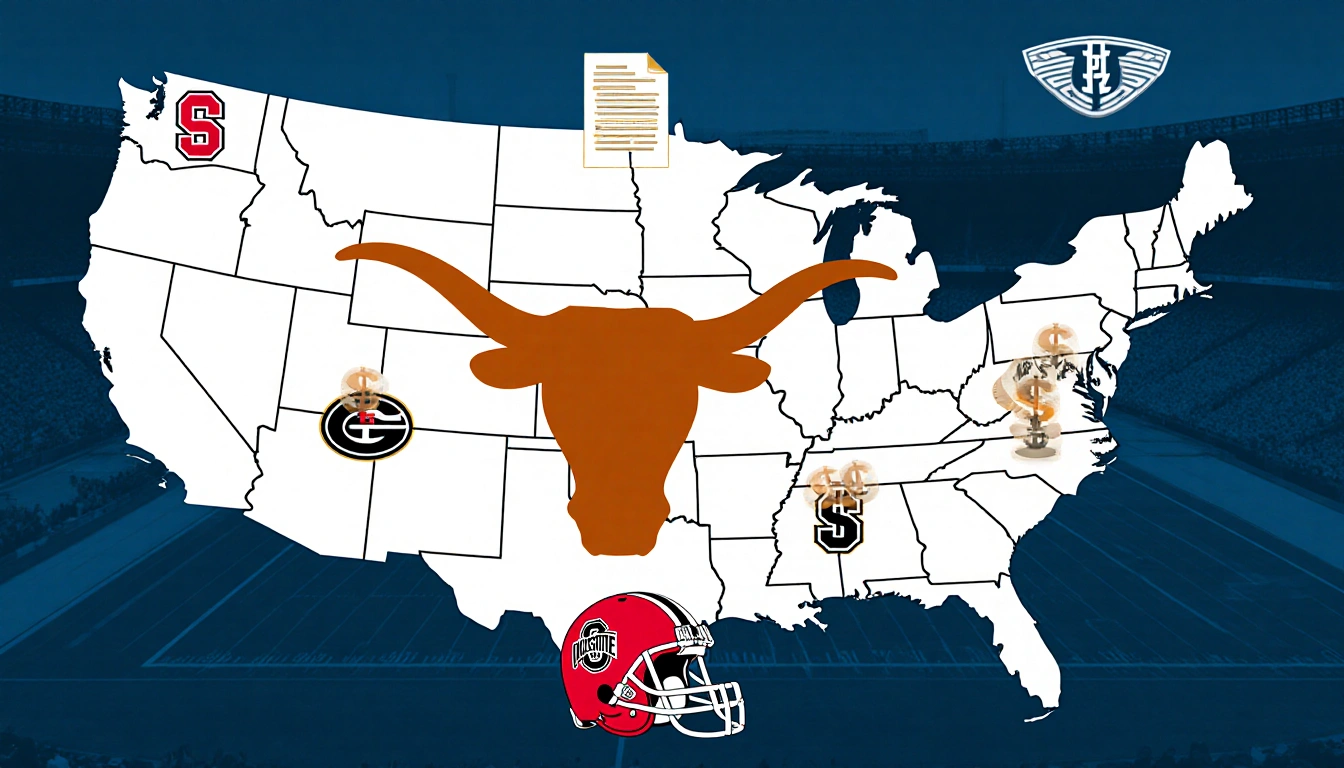
On Friday, CNBC senior sports reporter Michael Ozanian released the most recent list of the 75 most valuable college athletic programs for 2025, and the Texas Longhorns topped the chart with a valuation of $1.475 billion, overtaking Ohio State.
The list begins at $190 million for No. 75 and climbs to nearly $1.5 billion for the top spot, a range that illustrates how much the business of college sports has expanded.
In 2024, only four schools were valued above $1 billion; the following year that number jumped to thirteen, and the combined worth of the top 75 programs rose to $51.21 billion, a 13 % increase over last year’s $45.14 billion.
At the summit, Texas dethroned Ohio State, which moved from $1.318 billion in 2024 to $1.35 billion in 2025, while Texas A&M secured third place at $1.32 billion, followed by Georgia at $1.16 billion and Michigan at $1.155 billion.
Other programs that crossed the $1 billion threshold include Notre Dame, Tennessee, USC, Alabama, Nebraska, Penn State, LSU, and Oklahoma.
Ozanian explains that program valuations are built from the total revenue of all sports at a school and then multiplied by an average factor of four.
“We value these athletic programs based on the total revenue of all the sports that they have at the school,” Ozanian said. “And then we apply a multiple, typically around four, to those revenues. So, if revenue is $100 million, then the athletic program would be worth $400 million.”
He added that the multiple can shift because of name, image, and likeness (NIL) earnings, noting that starting in 2026 those proceeds will appear on the athletic balance sheet.
“Proceeds for name, imaging, and likeness, which now schools can pay the athletes, are gonna be on the athletic program balance sheet … schools based on the court ruling are gonna be paying student athletes money for past performance that they’ve had.”
Ozanian warned that schools may need external capital, such as institutional or private equity, to cover expenses that the athletic program alone cannot generate.
“It’s not a good thing,” Ozanian said.
For example, Texas earns no revenue from student fees and receives no government institutional funds, while Rutgers, which did not make the top‑75 cut, earned $137 million in 2024, of which $15 million came from student fees and another $14 million from institutional and government support.
The influence of television contracts is clear, as Ozanian noted that the Big Ten’s average annual TV value is $1.15 billion, with the SEC second at $710 million, translating into $63 million per Big Ten school and $52.5 million per SEC school.
Because the top five teams all belong to the SEC or Big Ten, their football programs generate roughly five times the revenue of the top five basketball programs such as Duke, Louisville, Kentucky, UNC, and Syracuse.
Ozanian said, “This is why these TV deals are so important because it’s the football that’s driving it,” and added, “And when you look at the ratings on TV, the only thing second to the NFL is college football … Professional basketball, baseball, hockey, they’re a distant third, fourth, fifth, sixth, to college football.”
Texas’s $322 million in revenue included $69 million from corporate sponsorships, advertising, and licensing, $61 million from ticket sales, and $137 million in fiscal donations last year, compared with Ohio State’s $53 million and Michigan’s $45 million.
The contrast between USC and UCLA illustrates how a private school can outperform a nearby public rival; USC’s recent move to the Big Ten and its stronger licensing, merchandising, and donor streams lift it above UCLA.
Similarly, the public University of Florida ranks 14th, while the private University of Miami falls to 29th, a difference that reflects both conference affiliation and institutional revenue sources.
Ozanian acknowledged that the growing television revenue and the shift toward athlete compensation create tension, but he remains optimistic about the sport’s business prospects.
“You can’t have these enormous television deals and the schools making all this money and then say to the players, you can’t have any of it, as it’s just become a huge business,” Ozanian started. “Clearly it’s become professionalized and part of that now is accepting the fact that the athletes are part of the model and drive this revenue and are gonna get some of the money from it.”
“So it’s gonna create some turmoil and we’ll see how this all plays out if and when the big outside money comes in. But as far as the popularity of the sport and the business side of the sport, I’m bullish.”
Key Takeaways
- Texas Longhorns lead the 2025 valuation list with $1.475 billion, surpassing Ohio State.
- The top 75 programs now total $51.21 billion, up 13 % from last year.
- Television contracts, especially in the Big Ten and SEC, are the primary revenue driver, and NIL earnings are reshaping the valuation model.
With the expansion of TV deals, the rise of NIL revenue, and the increasing professionalization of college athletics, Ozanian sees both challenges and opportunities ahead, but he ultimately remains bullish on the sport’s financial future.